
- HOME
- Careers
- Researchers' Voices
- Where Global Minds Pioneer the Future of Matter: David Weston Burke at WPI-SKCM²
Where Global Minds Pioneer the Future of Matter: David Weston Burke at WPI-SKCM²
Jun 1, 2026
Where Global Minds Pioneer the Future of Matter: David Weston Burke at WPI-SKCM2
Note: Interviewed in January 2026. Positions and titles are current as of the time of the interview.
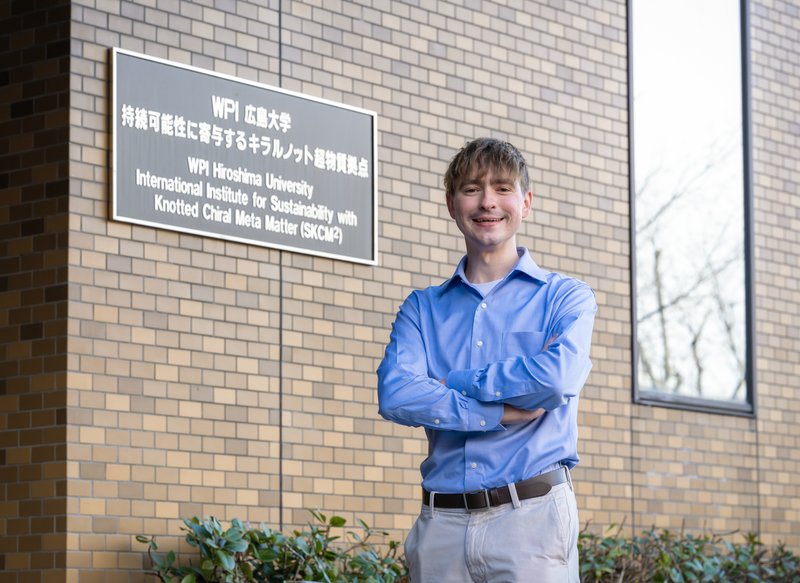
David Weston Burke, Assistant Professor (Special Appointment), International Institute for Sustainability with Knotted Chiral Meta Matter (WPI-SKCM2), Hiroshima University.
Programmable Materials for a Greener Future
A specially appointed assistant professor at the institute, Burke is developing porous molecular assemblies that can change their structures and properties in response to light, mechanical force, or chemical stimuli, with the aim of using these materials to remove unwanted molecules from our air and water. This approach aligns closely with WPI-SKCM2‘s mission to create entirely new forms of matter through interdisciplinary collaboration.
Burke’s research career has been shaped by a long-standing fascination with how the precise organization of small molecules over extended length scales can produce materials with exotic properties suitable for tackling complex societal challenges. At WPI-SKCM2, he has found an environment that encourages precisely this kind of boundary-crossing science.
“The empty space inside these materials can be engineered to interact with specific molecules in our environment,” says Burke. “Depending on how we design the channels inside these materials, we can program them to grab onto carbon dioxide and pull it out of the atmosphere, or pull chemicals out of our water supply to make it safe to drink.”
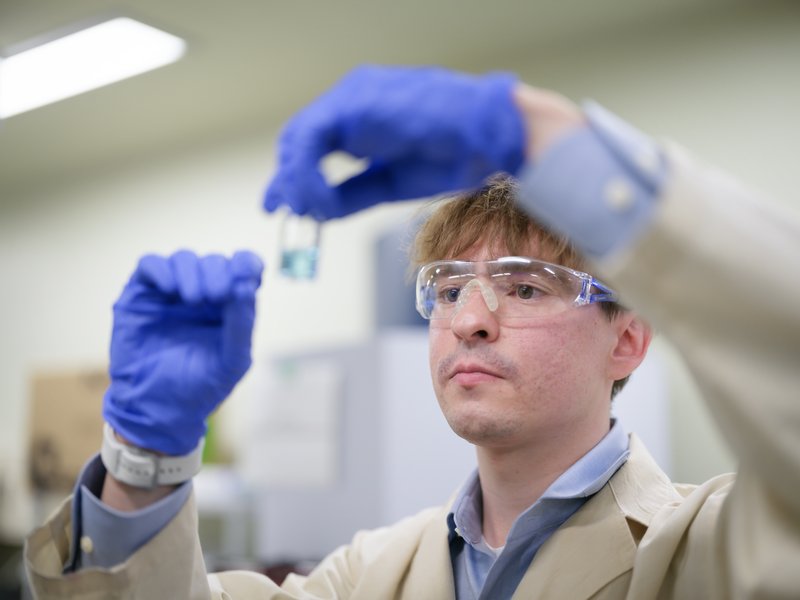
Burke in the laboratory. His research focuses on assembling molecular building blocks into extended porous networks to address contemporary challenges in environmental sustainability.
From Magic to Experimenting
Burke grew up in Bloomington, Indiana, the United States, where his parents brought him to science fairs at Indiana University as a child. He was enchanted by the chemistry demonstrations and remembers them as something straight out of Harry Potter—”the closest thing to real-life magic.”
He later returned to the campus and studied chemistry as an undergraduate before moving to Northwestern University to complete a Ph.D. in Chemistry, where his dissertation research was focused on covalent organic frameworks (COFs). These are highly ordered, porous polymer networks built from organic building blocks, and have attracted attention for applications ranging from chemical separations to electronics. His doctoral work emphasized not only how to synthesize them, but how subtle changes in their chemical structure can dramatically alter their macroscopic properties.
From 2022 to 2024, Burke was a JSPS International Research Fellow at Kyoto University’s Institute for Integrated Cell-Material Sciences (WPI-iCeMS). His research focus was influenced by the center’s former director, KITAGAWA Susumu, a specialist in porous coordination polymers who won the 2025 Nobel Prize in Chemistry, along with Richard Robson and Omar M. Yaghi, for the development of metal-organic frameworks—porous crystals that can be rationally designed to capture specific substances.
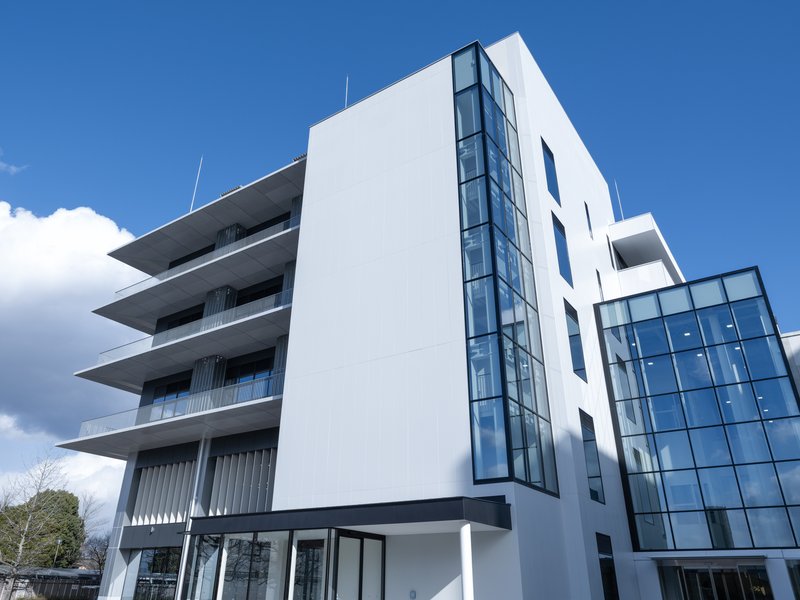
Science Knot, the newly established WPI-SKCM2 building at Hiroshima University—a freshly completed global hub pioneering the emerging field of “knotted chiral meta-matter” for a sustainable future.
Research Fueled by Diversity and Collaboration
In Kyoto, Burke attended a presentation on porous crystals by SATO Hiroshi of the RIKEN Center for Emergent Matter Science that made a profound impression on him. After an introduction from his advisor, Burke joined Sato’s group in 2024 at the newly established WPI-SKCM2 at Hiroshima University. That transition is an example of how the WPI ecosystem can support a long-term career path across different top-tier institutes in Japan.
In Hiroshima, Burke is now developing porous materials that respond dynamically to external stimuli, such as light or mechanical stress, allowing their properties, such as flexibility and guest uptake selectivity, to be tuned on demand, while promoting their durability. This research speaks directly to the meta-matter concept at the heart of WPI-SKCM2—materials exhibiting properties rarely observed in nature, which emerge due to the structure of their building blocks.
The idea isn’t just to make new materials, Burke explains, but to understand how the organization of discrete molecules within those materials creates emergent properties, and then to use those properties to tackle real-world challenges and improve our quality of life.
For Burke, what makes WPI-SKCM2 distinctive is the intellectual freedom that comes from working in a highly interdisciplinary environment. Researchers are studying knots, chirality, topology, and sustainability from the perspectives of mathematics, physics, chemistry, and biology, all in one place, he says, adding that the institute is structured so that discussions between scientists with varied expertise happen naturally. These discussions, in turn, create opportunities to build collaborative projects that would be difficult to pursue within a single discipline. Burke notes that this diversity has already influenced how he frames research questions.
“Based on my experience at both WPI centers, they’re diverse in two ways,” says Burke. “At a most basic level, people come from many different countries, and different cultural backgrounds bring different ways of thinking about science. There’s also diversity in terms of technical expertise. While WPI-iCeMS pursues integrated cell-material sciences at the interface of chemistry and biology, WPI-SKCM2 blends mathematics, physics, chemistry, and biology with the aim of discovering entirely new forms of matter.”
This mindset is particularly important given WPI-SKCM2‘s emphasis on sustainability. By designing porous materials that are more efficient, adaptable, and durable, Burke’s work contributes to broader efforts to reduce energy consumption and material waste in chemical separation processes. His materials, for example, could eventually be incorporated into separation membrane technologies that require less energy input than conventional alternatives, greatly reducing their carbon footprint and increasing their economic viability.
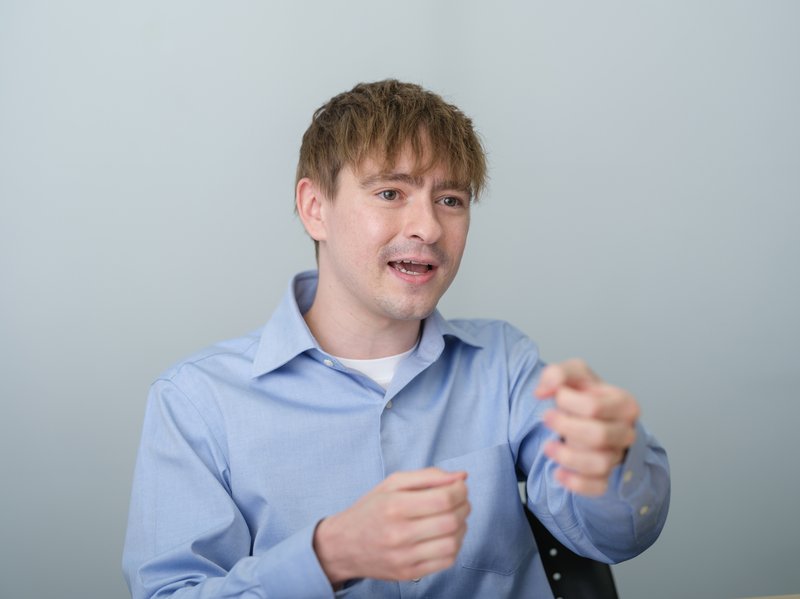
“A place to grow.” Burke reflects on how the WPI ecosystem—with its emphasis on high-risk, high-reward research—creates an ideal environment for early-career researchers to thrive in Japan.
A Catalyst for Independent Research: The WPI Advantage
Asked what sets WPI-SKCM2 apart from other research environments, Burke returns to the center’s focus on ideas that do not yet exist in nature. Researchers are not just optimizing known systems but trying to create new concepts and new kinds of matter, he says.
That ambition, coupled with strong institutional support, makes WPI-SKCM2 an attractive place for early-career researchers. Access to state-of-the-art facilities, close interaction with senior scientists, and the freedom to pursue high-risk ideas all contribute to an environment where unconventional projects can flourish.
The support extends beyond the laboratory. Burke notes that administrative support has proven invaluable—both at WPI-iCeMS in Kyoto and now at WPI-SKCM2 in Hiroshima—in helping him navigate the complexities of Japanese bureaucracy. “I can speak Japanese conversationally now, but when I first arrived, I could barely say anything, and reading is still a challenge,” he says. Outside the center, Burke has immersed himself in local life with characteristic openness: studying Japanese at a language club in Kyoto, and in Hiroshima, joining a local band as its only international member. “Being open-minded is really important for thriving both personally and as a researcher,” he reflects.
As WPI-SKCM2 continues to grow, Burke sees his role evolving alongside the center. In the coming years, he aims to deepen his research into responsive porous materials while expanding his teaching portfolio and mentoring younger researchers. His trajectory reflects the broader goals of WPI-SKCM2: to integrate discovery, collaboration, and education in pursuit of materials that can address pressing global challenges. From Bloomington, Indiana to Hiroshima, he has found the right environment to pursue his ambitions at WPI-SKCM2.
“Not only is Japan a beautiful place to live with an interesting culture, delicious food, and considerate people,” Burke says, “but a place that encourages and invests in high-level science. It’s a place where I could really see myself building a long-term career doing the type of work that I love.”
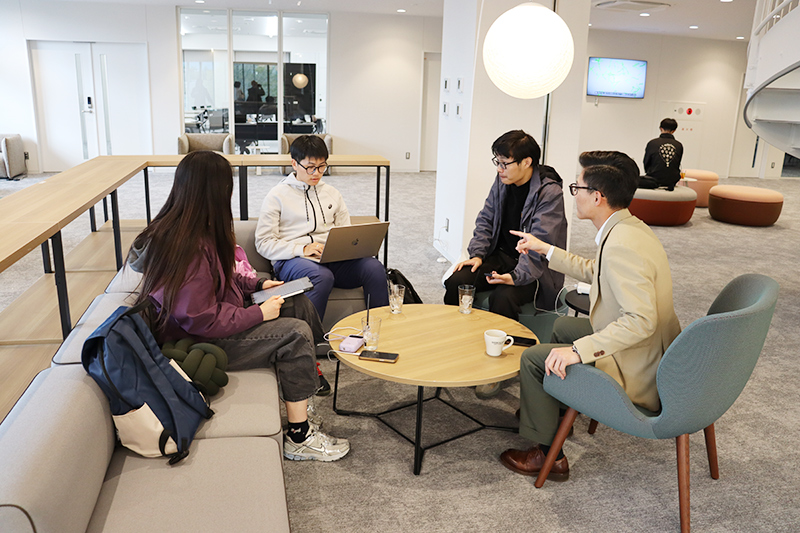
Designed for synergy, the open, modern interior of WPI-SKCM2 serves as a platform where the ambitious challenges of researchers like Burke are turned into reality through spontaneous collaboration.
David Weston Burke
Undergraduate Research Assistant, Indiana University (2014–2017)Undergraduate Research Intern, The University of Tokyo (2016)
Ph.D. in Chemistry, Northwestern University (2017–2022)
JSPS International Research Fellow, WPI-iCeMS, Kyoto University (2022–2024)
Assistant Professor (Special Appointment), WPI-SKCM2, Hiroshima University (2024–)