
- HOME
- Careers
- Researchers' Voices
- Visualizing Molecular Recognition at the Nano–Life Interface: Sk Asif Ikbal at WPI-NanoLSI
Visualizing Molecular Recognition at the Nano–Life Interface: Sk Asif Ikbal at WPI-NanoLSI
May 15, 2026
Visualizing Molecular Recognition at the Nano–Life Interface: Sk Asif Ikbal at WPI-NanoLSI
Sk Asif Ikbal is an Assistant Professor at the Nano Life Science Institute (WPI-NanoLSI) at Kanazawa University, where he specializes in supramolecular chemistry. Since joining the center in its early years, he has leveraged its world-class nanometrology to bridge the gap between fundamental chemistry and biomedical applications. Ikbal spoke with us about his journey from India to Kanazawa and how the interdisciplinary environment of the WPI center has shaped his research and contributed to efforts addressing diseases such as cancer.
Note: Interviewed in January 2026. Positions and titles are current as of the time of the interview.
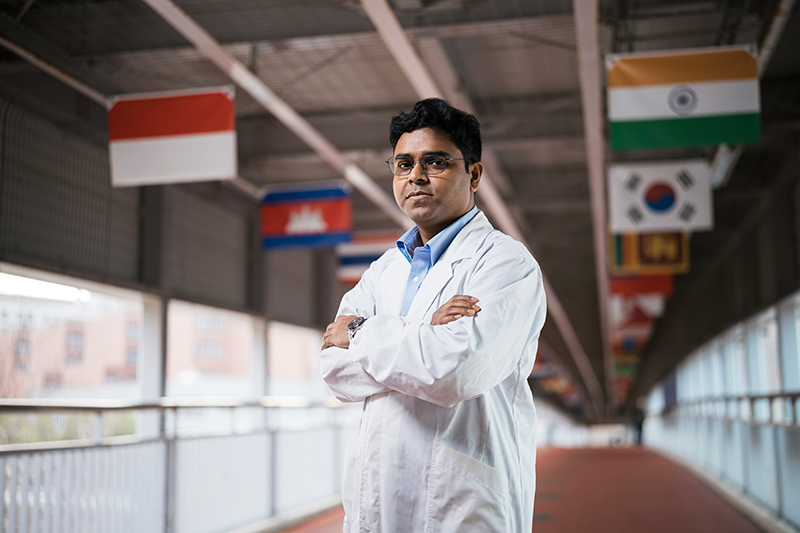
Sk Asif Ikbal, Assistant Professor, Nano Life Science Institute (WPI-NanoLSI), Kanazawa University.
A Quest for Interdisciplinary Science and High-Precision Research
Ikbal remembers the excitement he felt in 2018 when he was working as an assistant professor of chemistry at an engineering college in India and contemplating his next career step. He was eager to push his research beyond disciplinary boundaries, particularly toward applications that connect chemistry with biology and nanoscience. Japan, with its reputation for precision science and advanced instrumentation, stood out as a place where such ambitions might be realized.
“I was specifically looking for an environment where I could do high-quality research and collaborate closely with researchers in biology and nanometrology,” Ikbal recalls. That search eventually led him to WPI-NanoLSI at Kanazawa University, where he is now an assistant professor specializing in supramolecular chemistry—the study of how molecules assemble and interact through weak, reversible forces instead of permanent chemical bonds.
Ikbal’s recruitment to WPI-NanoLSI coincided with the center’s formative years. After discovering an assistant professor position on Japan’s JREC-IN portal, he contacted Professor AKINE Shigehisa and submitted a detailed research plan. Following document screening and an online interview, he was offered a Specially Appointed Assistant Professor position in the Akine Group.
“I joined WPI-NanoLSI when the WPI center was newly established at Kanazawa University,” Ikbal says. “The vision of creating a truly interdisciplinary institute bridging nanoscience and life science closely matched my research interests and long-term career goals.”
From the outset, Ikbal was not only conducting research but also participating in discussions about how the new center should function. This early involvement gave him insight into WPI-NanoLSI’s long-term strategy and fostered a strong sense of belonging. “Being part of the center from its early stage allowed me to grow alongside it,” he notes.
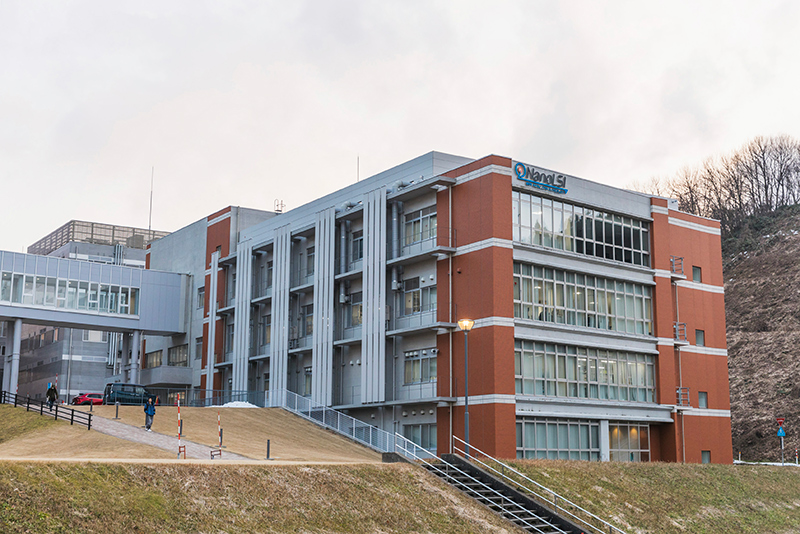
The WPI-NanoLSI building at Kanazawa University’s Kakuma Campus, providing an inspiring environment where nature and cutting-edge science coexist.
Crossing Disciplinary Boundaries at the Nanoscale
WPI-NanoLSI promotes interdisciplinary research that bridges nanometrology, life science, supramolecular chemistry, and computational science, with the goal of understanding the mechanisms of life at the nanoscale.
Specializing in supramolecular chemistry, Ikbal is currently engaged in three major projects, all of which involve cross-disciplinary collaboration. One project integrates life sciences, while the other two are conducted in collaboration with nanometrology researchers.
In his collaboration with life scientists, Ikbal focuses on lactate, a metabolite known to contribute to cancer progression. The aim is to suppress cancer cell growth by controlling lactate’s activity within the body. Working closely with cancer researchers at the center, he is developing artificial molecules that bind selectively to lactate and act as a “sponge” to absorb it. “This project is extremely challenging, but we are beginning to see promising results. It is currently my top priority,” Ikbal says.
One of his collaborations with nanometrology researchers seeks to enhance the performance of atomic force microscopy (AFM), which enables surface analysis at the nanometer scale, by developing metal-complex-based chemical materials to functionalize the tips of silicon probes. The other research direction focuses on developing time-programmable molecular systems based on stimuli-responsive chiral metal complexes. By controlling the rate of structural conversion through external stimuli, these systems could function as nanoscale “chemical clocks” with predictable timing of chirality inversion.
“I collaborate with both the biology and nanometrology groups, and the center’s internal collaborative programs mean there are no hurdles when it comes to launching joint research. We are like a family—we understand one another’s work. When I propose an idea, interested colleagues naturally come together. I feel very supported by this environment,” Ikbal says.
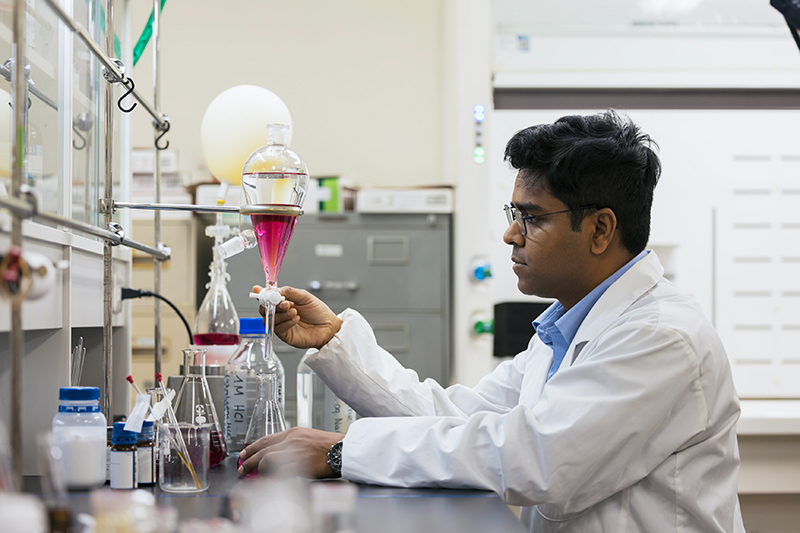
Ikbal working in the laboratory. His research combines supramolecular design with advanced nanometrology to explore molecular recognition at the nanoscale.

Natural Science and Technology Hall, Kanazawa University. A corridor connecting it to the WPI-NanoLSI research building allows researchers to move freely between the facilities, which in turn helps spark spontaneous discussions and cross-disciplinary synergy among chemists, physicists, and biologists.
Comprehensive Support for a Global Research Career
Ikbal has witnessed WPI-NanoLSI’s growth from a newly established WPI center into an internationally recognized research hub.
He credits the WPI framework with enabling this transformation. Long-term funding, access to shared facilities, and strong administrative support allow researchers to pursue high-risk, high-reward projects while maintaining global visibility. He acknowledges the role of Director FUKUMA Takeshi, together with all PIs and staff members, in maintaining a smooth research environment and well-functioning facilities.
“I have seen the center evolve from an ambitious concept into a mature institute with a clear scientific identity,” he says. “The WPI framework promotes international collaboration, strategic research planning, and researcher autonomy.”
Beyond research, Ikbal emphasizes the importance of institutional support for daily life. When he arrived in Japan, he spoke little Japanese and was relocating with his family. WPI-NanoLSI staff assisted with housing, utilities, immigration procedures, healthcare visits, and school.
“They have supported me with essential tasks such as finding an apartment, setting up phone and internet services, visiting hospitals, going to the immigration office, and enrolling my son in school. Staff members frequently accompany us when Japanese language assistance is required,” Ikbal says. “This comprehensive support has greatly facilitated my family’s adjustment to life in Japan.”
“WPI distinguishes itself through its exceptional support for foreign researchers,” he adds. The sense of security and stability, he says, has allowed him to focus fully on research and long-term career development.

“Growing alongside the center.” Ikbal discusses the strategic advantages of the WPI framework and its role in fostering researcher autonomy and international collaboration.
Looking Ahead: Shaping the Next Generation of Science
Ikbal aims to deepen his interdisciplinary research at the intersection of chemistry, nanoscience, and life science. His future goals include advancing time-programmable chiral molecular systems, refining artificial receptors for biomedical applications, and further developing AFM-based techniques for probing molecular function.
“My objective is to elucidate structure–function relationships at the nanoscale and translate fundamental discoveries into practical applications,” he says.
He is also committed to mentoring early-career researchers and building international collaborations, reflecting the WPI program’s broader mission. For scientists considering a WPI center, Ikbal stresses that the appeal goes far beyond individual research projects.
“A WPI center offers a rare environment where ambitious science, long-term career development, and personal life can be pursued together,” he says. “The combination of stable, long-term funding, genuine interdisciplinary collaboration, and comprehensive support for international researchers and their families makes it possible to focus fully on high-impact research without constant uncertainty.”
Having experienced an international move himself, Ikbal sees WPI centers as uniquely positioned to attract researchers who want not only to conduct excellent science, but also to build a sustainable global career.
“It is an opportunity to grow scientifically while helping shape an institute from within, in a truly international setting,” he adds.
Sk Asif Ikbal
Ph.D. in Chemistry, Indian Institute of Technology Kanpur (2015)Research Associate, Indian Institute of Technology Kanpur (2015)
Postdoctoral Researcher, Institute of Catalysis Research Lyon and École Centrale de Marseille (2016–2017)
Assistant Professor, Jabalpur Engineering College (2018)
Assistant Professor, WPI-NanoLSI, Kanazawa University (2018–)