
- HOME
- Careers
- Researchers' Voices
- From Mongolia to Japan, Tackling the Unknowns of Nanoplastics with
Cutting-Edge Research Infrastructure: Batdulam Battulga at WPI-AIMEC
From Mongolia to Japan, Tackling the Unknowns of Nanoplastics with
Cutting-Edge Research Infrastructure: Batdulam Battulga at WPI-AIMEC
May 8, 2026
From Mongolia to Japan, Tackling the Unknowns of Nanoplastics with Cutting-Edge Research Infrastructure: Batdulam Battulga at WPI-AIMEC
Plastic pollution extends from rivers to oceans worldwide. Among the most elusive targets in plastic pollution research are nanoplastics—particles so small that they are extremely difficult to detect and analyze. Batdulam Battulga, originally from Mongolia, is tackling this challenge at the Advanced Institute for Marine Ecosystem Change (WPI-AIMEC), hosted by Tohoku University and the Japan Agency for Marine-Earth Science and Technology (JAMSTEC). Utilizing state-of-the-art synchrotron radiation facilities and advanced research infrastructure, she is developing new methods to characterize nanoplastics.
After earning her Ph.D. and conducting research at the Japan Atomic Energy Agency (JAEA), what led her to choose the newly established WPI-AIMEC? Battulga spoke to us about her journey and her challenges as an early-career researcher.Note: Interviewed in January 2026. Positions and titles are current as of the time of the interview.
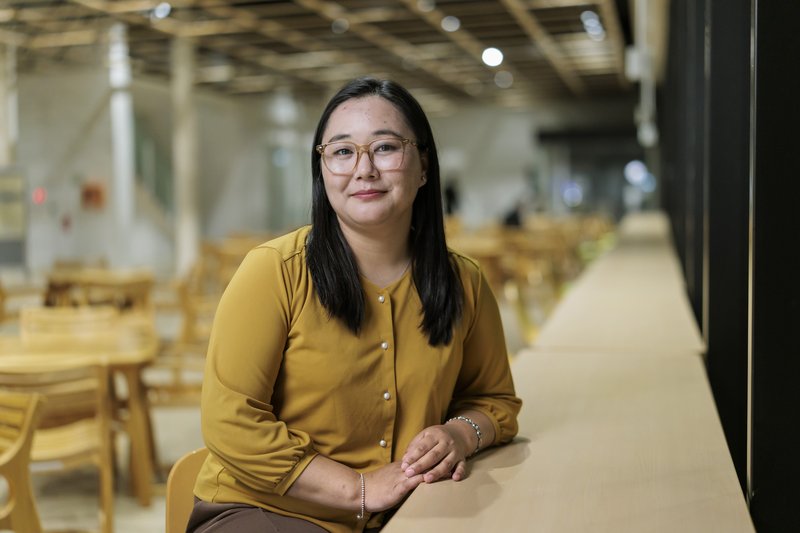
Batdulam Battulga, Postdoctoral Researcher at the Advanced Institute for Marine Ecosystem Change (WPI-AIMEC), hosted by Tohoku University and the Japan Agency for Marine-Earth Science and Technology (JAMSTEC).
Pioneering Nanoplastics Research at WPI-AIMEC
“My main research theme is to understand the impacts, roles, and behavior of plastic debris, from macro- to micro-sized particles, in both terrestrial and aquatic environments,” Battulga explains with a smile.
“Currently, I am focusing on even smaller particles—nanoplastics.”
Nanoplastics refer to plastic particles at the nanoscale. They are generated when plastic debris in the environment degrades and fragments. When taken up by organisms, they may damage cells and tissues, raising concerns about their impacts on ecosystems and human health.
“Nanometer-scale particles are extremely difficult to identify, and research in this area is still limited,” says Battulga. “However, we have access to the 3 GeV high-brilliance synchrotron radiation facility NanoTerasu, which enables us to measure and characterize the properties of nanoplastics.”
WPI-AIMEC aims to elucidate the mechanisms behind changes in marine ecosystems in response to Earth system variations such as climate change, and to improve predictions of their future trajectories. By integrating ocean physics, ecology, and mathematical and data sciences, the center provides access to advanced research infrastructure, cutting-edge ocean observation capabilities, and high-performance computational platforms through its two host institutions: Tohoku University and JAMSTEC.
NanoTerasu, located on the Tohoku University campus, is one such key facility. Using synchrotron radiation, it enables researchers to analyze structures and properties at the nanoscale—one-billionth of a meter—opening new possibilities for scientists like Battulga to investigate nanomaterials.
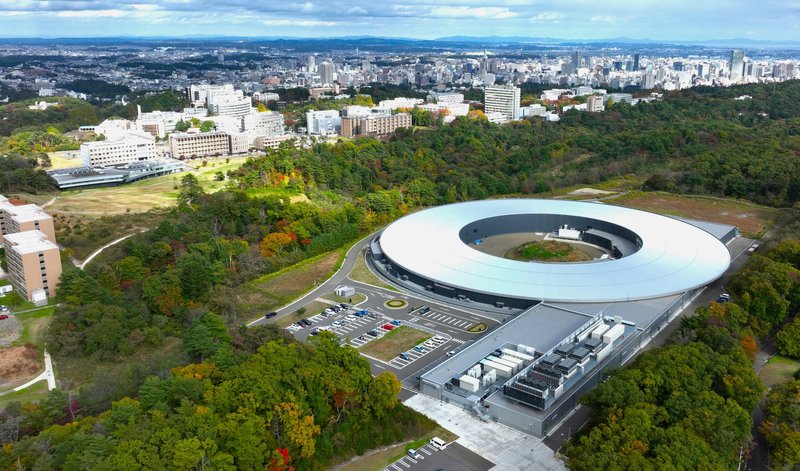
NanoTerasu, a public–private synchrotron radiation facility located on the Tohoku University campus, is one of the key research facilities supporting WPI-AIMEC.
(Photo: NanoTerasu)
A Scientific Journey that Began with Mongolian Rivers
Battulga’s journey as a scientist began with rivers in Mongolia. As an undergraduate student, she participated in field surveys under a hydrology professor, collecting river water samples and conducting chemical analyses.
“Collecting samples myself, analyzing them in the laboratory, and interpreting the environmental conditions from the results—that entire process fascinated me,” she recalls.
Through international collaborative research with Japanese scientists, she became determined to pursue a Ph.D. in Japan. After completing her master’s degree in Mongolia, she came to Japan as a research student and later entered the doctoral program at Tokyo Metropolitan University. Initially, her research focused on the movement of heavy metals in river systems from a pollution perspective. However, following advice from her supervisor, she shifted her focus to plastic pollution—a decision that shaped her current specialization.
“In Mongolia, mining activities and urban pollution contribute significantly to river contamination, so heavy metals were an important topic,” she explains. “But another Mongolian student working in my supervisor’s group was researching a similar topic, so I began looking for a different direction, which led me to plastic research.”
After earning her Ph.D., she worked as a postdoctoral researcher at the Japan Atomic Energy Agency (JAEA), where she investigated interactions between radioactive nuclides such as radiocesium and plastics in the environment.
“Plastics are not only pollutants themselves—they can also act as carriers for other organic and inorganic contaminants,” she says.
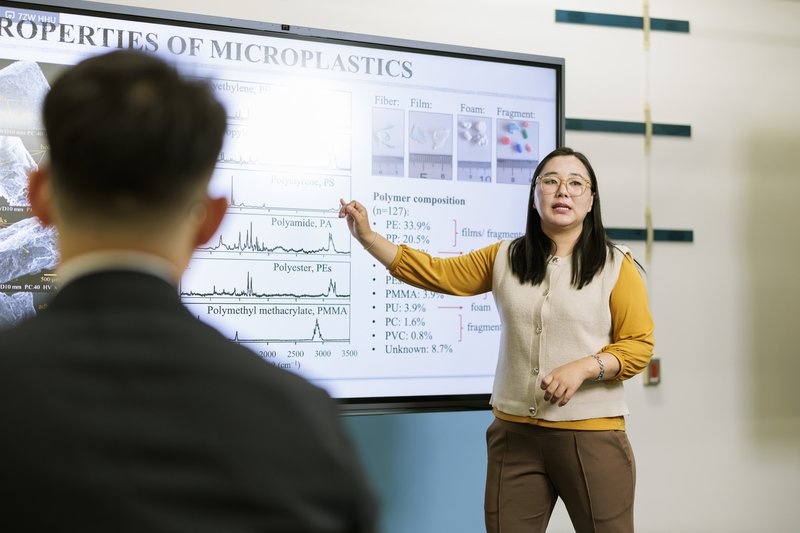
Battulga giving a presentation on her research into microplastics.
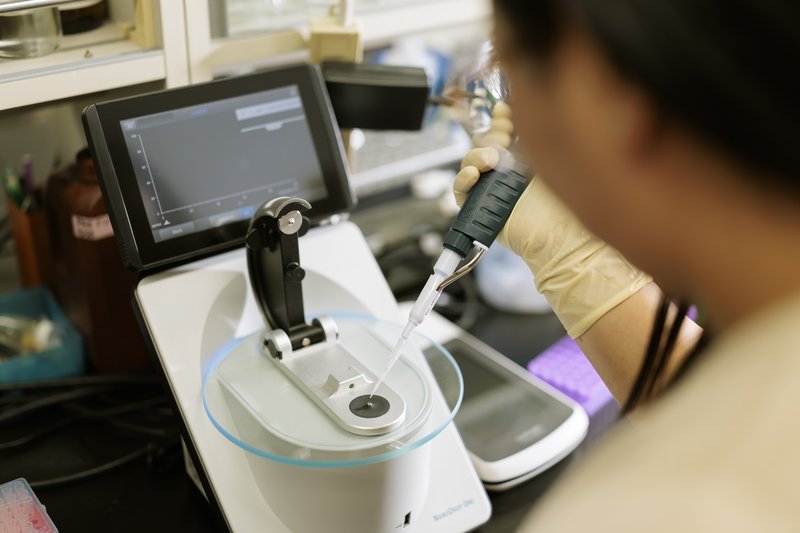
Battulga conducting experiments to study microorganisms found on plastic in the laboratory.
Becoming a Creator of Research as an Early-Career Scientist
In 2024, following the completion of her contract at JAEA and the birth of her first child, Battulga began searching for the next step in her career. That led her to WPI-AIMEC.
“I needed both stability and academic freedom. I was looking for an environment where I could grow as a researcher and propose my own research themes. When I found WPI-AIMEC’s website through the JREC-IN research careers portal and read about its research vision, I was strongly drawn to it,” she says.
“I wanted to pursue cutting-edge science while also creating my own research story. What attracted me most was that WPI-AIMEC is a new research center. In many established institutions, you often follow predefined themes, but at WPI-AIMEC, even early-career researchers can contribute to defining the institute’s Grand Challenges.”
After spending a year and a half there, she feels that her instincts were right. WPI-AIMEC provides access to advanced instruments and technologies essential for high-quality experimental research. She also values the strong support for research funding.
“There is substantial support for research and travel funding. We can apply for both competitive and non-competitive grants, and in the past year and a half, I have secured funding from at least three sources. In addition, WPI-AIMEC provides frequent opportunities to connect with researchers from diverse fields, which often lead to new collaborations and research ideas.”
Weekly science salons and semi-regular colloquia bring together PIs and researchers from different disciplines to discuss research in English. The intersection of physics, chemistry, biology, and modeling perspectives generates new research ideas. These events also provide valuable opportunities for interaction among researchers across WPI-AIMEC’s multiple sites, including Tohoku University, JAMSTEC, the University of Hawai‘i at Mānoa, as well as other international collaborators.
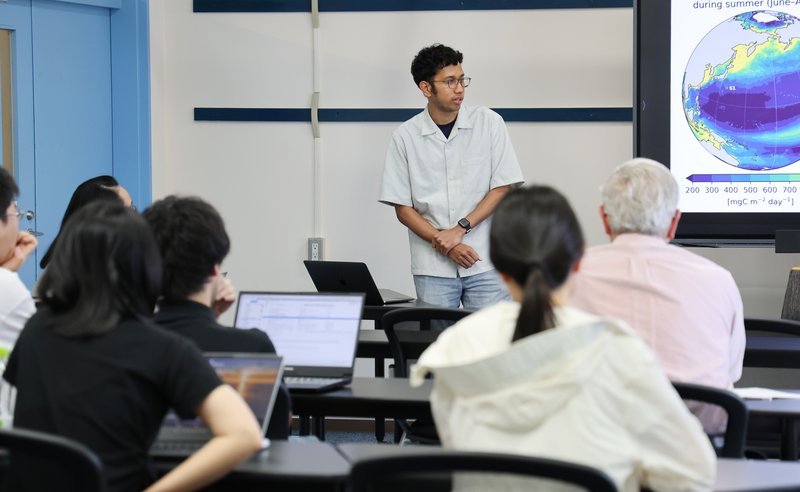
AIMEC Science Salon held in 2025. The salon is conducted weekly in a hybrid format, providing a forum for sharing diverse research insights in marine science.
(Photo: WPI-AIMEC)
Balancing Research and Parenting
Battulga currently lives in university-supported housing and uses the university’s childcare facilities. Support from WPI-AIMEC and its host institution plays a crucial role in enabling her to balance research and parenting.
“The WPI-AIMEC administration and Tohoku University provided extensive support, including information about family-friendly neighborhoods and housing options. I am both a mother and a researcher. For me, it is essential to work in a place where I can fully focus on research and continue to grow professionally. WPI-AIMEC is exactly that kind of place—it allows me to continue growing both professionally and personally.”
Beyond advancing her own research, Battulga is eager to contribute to building new research systems and educational initiatives.
“I am currently working to develop new methods for measuring and identifying nanoplastics and to establish frameworks that other researchers can use. I also hope to provide undergraduate and master’s students with knowledge and research themes on plastic dynamics, integrating perspectives from physics, chemistry, and biology.”
From rivers to oceans, from macro to micro and now to nano, her research moves fluidly across scales while addressing global environmental challenges. At WPI-AIMEC, Battulga continues to write the next chapter of her scientific story.
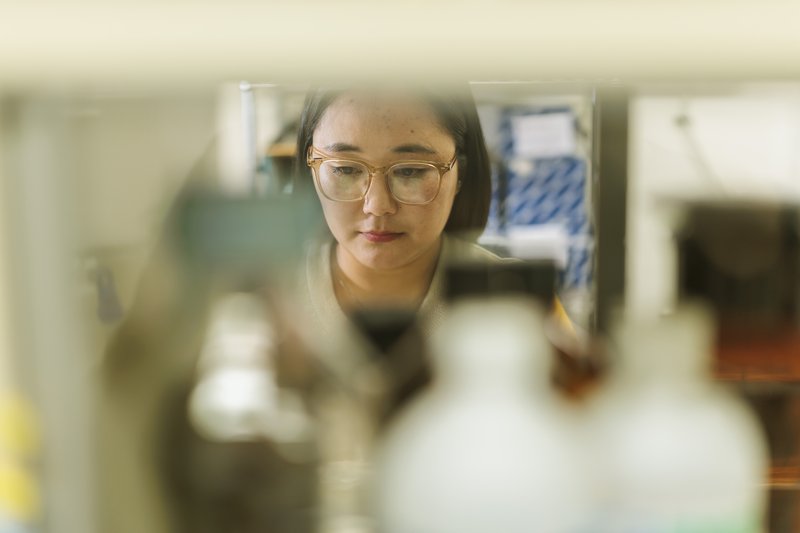
Batdulam Battulga
B.Sc. in Chemistry, Department of Chemistry, National University of Mongolia (2014)M.Sc. in Chemical Technology, School of Engineering and Applied Science, National University of Mongolia (2016)
Ph.D. in Science, Department of Geography, Tokyo Metropolitan University (2020)
Postdoctoral Researcher, Tokyo Metropolitan University (2020–2021)
Postdoctoral Researcher, Nuclear Science and Engineering Center, JAEA (2021–2024)
Postdoctoral Researcher, WPI-AIMEC, Tohoku University & JAMSTEC (2024–)