
- HOME
- Careers
- Researchers' Voices
- Supernova Tea Time: Robert Quimby and Kavli IPMU, WPI
Supernova Tea Time: Robert Quimby and Kavli IPMU, WPI
Apr 15, 2026
“Supernova Tea Time: Robert Quimby and Kavli IPMU, WPI
“I study stars that explode”—Robert Quimby’s single-sentence self-introduction is hard to beat. More technically, Quimby does research on what astronomers call “transients,” a category that includes novae, supernovae, and other phenomena. Now a Professor of Astronomy at San Diego State University (SDSU), from 2011 to 2014 Quimby was a Distinguished Postdoctoral Fellow at what is today the Kavli Institute for the Physics and Mathematics of the Universe (Kavli IPMU, WPI), the University of Tokyo. Quimby spoke to us about how his career observing the stars—and his time at Kavli IPMU, WPI, where he continues to serve as an Affiliate Member—have shaped his development as a researcher.
Note: Interviewed in January 2026. Positions and titles are current as of the time of the interview.
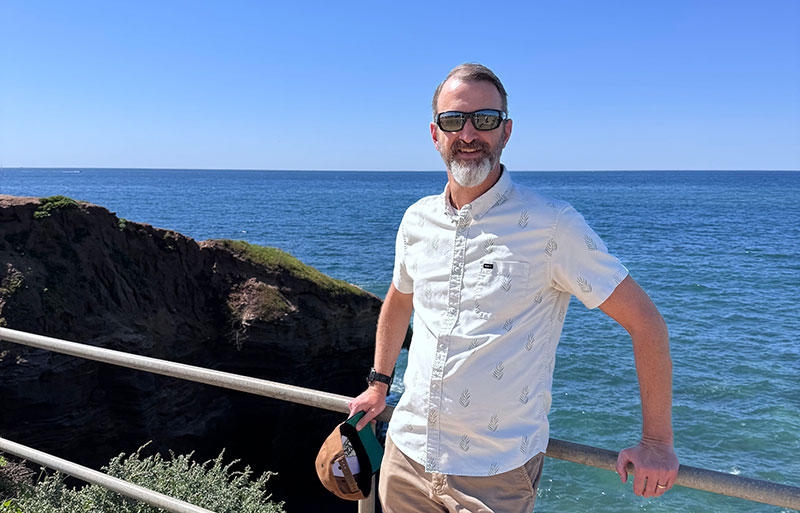
Robert Quimby, Distinguished Postdoctoral Fellow at Kavli IPMU, WPI from 2011 to 2014, now Professor of Astronomy, SDSU and Director, Mount Laguna Observatory. (Photo: Robert Quimby)
A Bright Beginning
Quimby’s journey into the world of supernovae began in his senior undergraduate year, when he volunteered at Lawrence Berkeley National Laboratory and, through sheer luck, ended up working with Dr. Saul Perlmutter on the Supernova Cosmology Project, says Quimby. Perlmutter’s project used observations of supernovae to prove that the universe is expanding at an accelerating rate, winning its lead researcher the 2011 Nobel Prize in Physics.
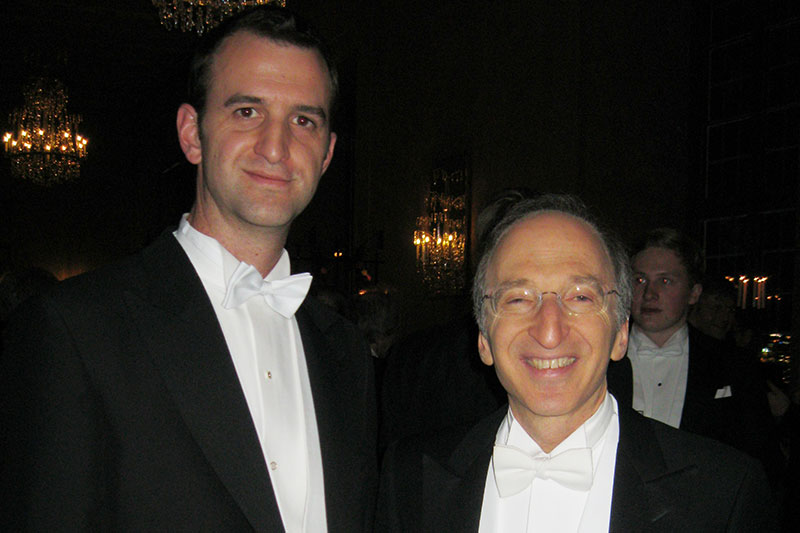
Robert Quimby with Nobel laureate Saul Perlmutter after the 2011 Nobel Banquet. (Photo: Robert Quimby)
“That was my first paper, and it won the Nobel Prize!” says Quimby. “It was also a turning point for me, showing me how transients could be used to do science.”
Quimby went on to conduct his own supernova search for his Ph.D. thesis at the University of Texas. “I knew I couldn’t compete with the big boys, so I decided that instead of finding the most supernovae, I was going to find the best supernovae,” says Quimby. “And in fact, the fourth one I found was ten times brighter than any that had ever been found before.”
A Professional Opportunity with a Personal Aspect
In 2011, Quimby was exploring future options as he neared the end of a postdoctoral position at the California Institute of Technology. During his search, he stumbled upon what was then a new institution called the Institute for the Physics and Mathematics of the Universe (WPI-IPMU) at the University of Tokyo.
WPI-IPMU intrigued Quimby for several reasons. It had an impressive roster of personnel and an ambitious focus on “doing big work—unlocking the mysteries of the universe.” On a personal level, he was also attracted to the prospect of working in Japan. Quimby had previously spent a year in Yamagata Prefecture as an assistant language teacher on the Japan Exchange and Teaching (JET) program. His wife is Japanese, too, and taking a position at WPI-IPMU would give their child the opportunity to experience life in Japanese culture.
“It was not without risk,” Quimby says. “But there were a lot of good people working there, and they had excellent programs for building international connections. I do have an adventurous streak, so I decided to go for it.”
The Power of Tea Time
There were no language barriers at Kavli IPMU, WPI, since all research and presentations were done in English. The institution also helped Quimby and his family find an apartment, set up bank accounts, and handle the other necessities of daily life. Still, some cultural differences occasionally required time and adjustment when building connections. What helped in this regard was tea time.
Tea time—informal discussion over tea and snacks between researchers with different specialization and at different stages of their career—is a longstanding tradition in the field of astronomy. Kavli IPMU, WPI embraced this tradition, organizing tea time events at an institutional level to encourage conversation between scientists from different backgrounds.
“I was a regular at tea time,” Quimby says. “I’d go there and say, ‘What’s that thing on the table there? How do I eat it?’ Connecting on a human level like that knocked down barriers. You could learn who was a mathematician, who was a physicist, and so on, and that came in handy.”
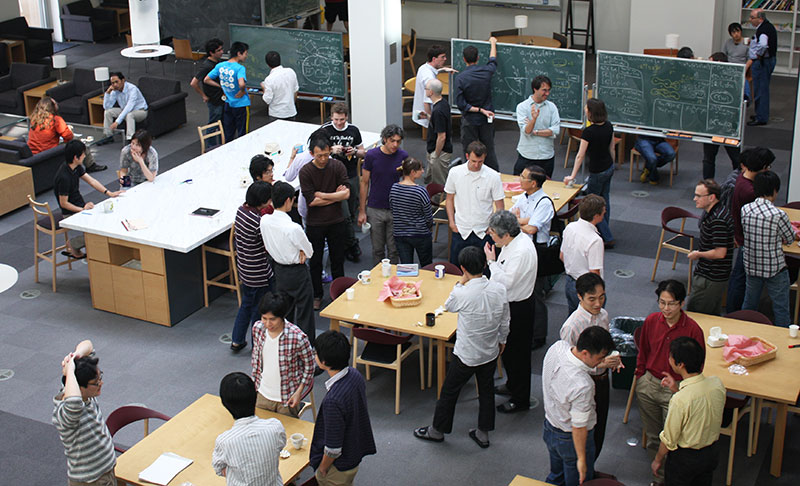
Tea time at Kavli IPMU, WPI, 2012. Quimby is near the center in a white shirt. (Photo: Kavli IPMU, WPI)
Collaboration and Connections Inside and Outside the Institute
Quimby appreciated Kavli IPMU’s institutional culture of openness to new ideas. “If I suggested something new, people would take it seriously,” he says. “They wouldn’t just dismiss it.” This, combined with the connections made at tea time between researchers in different fields, made surprising new discoveries possible.
One example Quimby offers is the time he observed a puzzling astronomical phenomenon. It looked like a Type Ia supernova, but it was thirty times brighter than expected. Quimby suspected that gravitational lensing was involved, and decided to build a team of experts to investigate.
“I needed someone who knew about strong lensing, so I literally walked down the hall and started talking to people,” Quimby says. “We built up a collaboration on the spot, and together we proved that what I had seen was the first strongly gravitationally lensed Type Ia supernova ever found. Having the right people right there helped a lot.”
Quimby also has praise for the support his team received from Kavli IPMU’s press office once the discovery was confirmed. “They put out a nice press release about our discovery, and that helped get the word out that we were doing some good stuff.”
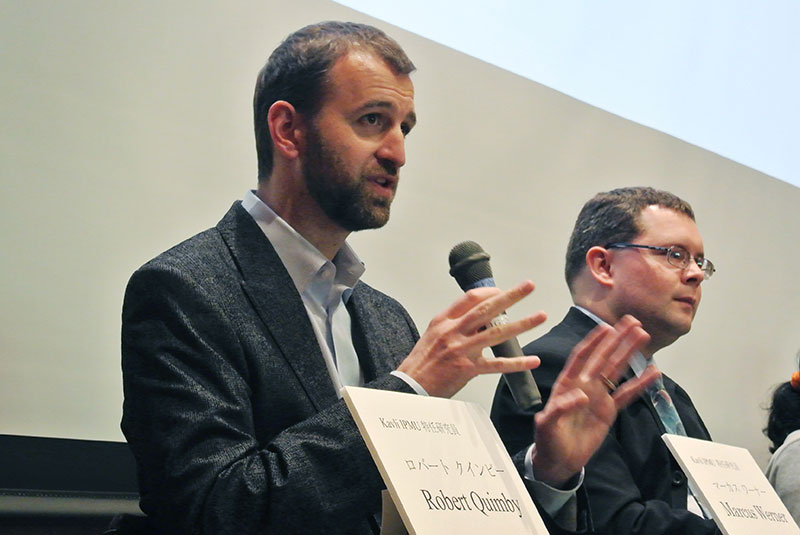
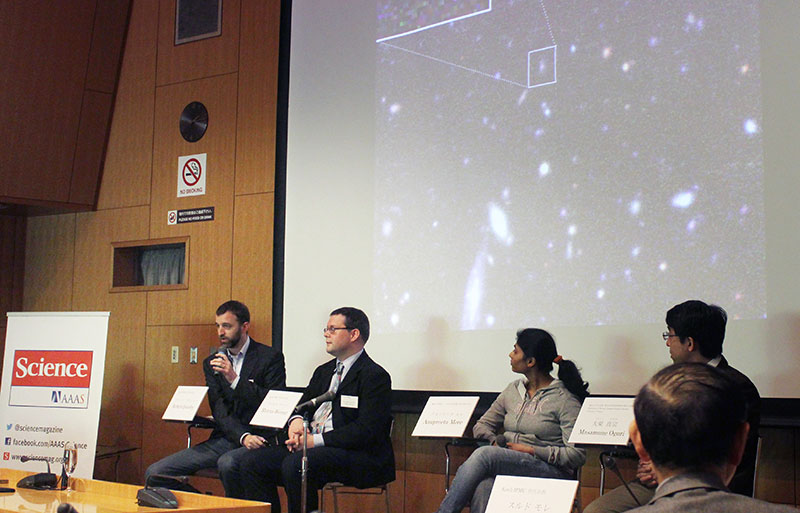
Quimby and colleagues at a 2014 press conference publicizing the discovery of a strongly lensed Type Ia supernova. (Photo: Kavli IPMU, WPI)
Kavli IPMU, WPI also had a strong culture of exchange with researchers from around the world. “We got lots of visitors—and good visitors,” Quimby says. “You were always in touch with what was hot, because those researchers would visit the institute. Instead of reading the papers on arXiv, you could just wait for the lead authors to come and explain them!”
Beyond Kavli IPMU, WPI
Today a tenured professor, Quimby balances teaching and research with leading roles in international research projects. The leadership experience he gained at Kavli IPMU, WPI, he says, prepared him well for guiding other international teams.
He also continues to explore the possibilities of transient observation as part of the science team for the Argus Array. This ambitious “high-cadence” observation project has 1,200 telescopes imaging the sky once per minute or even second, depending on the time of month—a significant advance on former surveys that captured one image per day.
What advice does he have for those considering a WPI position? Life in Japan may present challenges, he notes, with differences ranging from language to food. “In my case, being 190 centimeters tall also meant that I stood out,” he adds.
Still, he says, the experience of a position at a WPI center can be life-changing. “If you’re adventurous and willing to step outside your comfort zone, Kavli IPMU, WPI can be a great opportunity. Following the same trail as everyone else means missing out on the big discoveries, so don’t be afraid to try something different.”
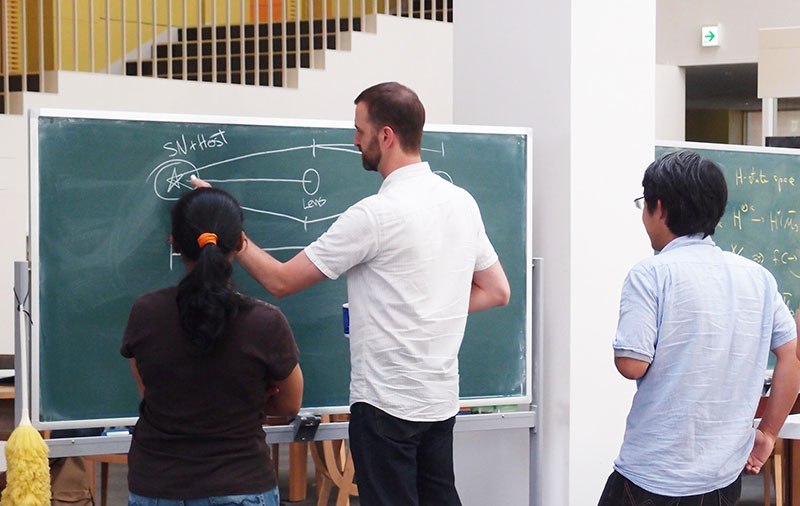
Kavli IPMU, WPI has blackboards in the halls for on-the-spot collaboration. Here Quimby discusses ideas with two colleagues, 2014. (Photo: Kavli IPMU, WPI)
Robert Quimby
Ph.D. in Astronomy, University of Texas, Austin (2006)Postdoctoral Scholar, California Institute of Technology (2007–2011)
Distinguished Postdoctoral Fellow, Kavli IPMU, WPI, The University of Tokyo (2011–2014)
Affiliate Member, Kavli IPMU, WPI, The University of Tokyo (2014–)
Director, Mount Laguna Observatory (2014–)
Professor of Astronomy, San Diego State University (2020–)