
- HOME
- Careers
- Researchers' Voices
- Fusing Neuroscience and Mathematics toward Future Clinical Applications in Spinal Cord Injury: YAMAGUCHI Reona at WPI-ASHBi
Fusing Neuroscience and Mathematics toward Future Clinical Applications in Spinal Cord Injury: YAMAGUCHI Reona at WPI-ASHBi
Apr 10, 2026
Fusing Neuroscience and Mathematics toward Future Clinical Applications in Spinal Cord Injury: YAMAGUCHI Reona at WPI-ASHBi
YAMAGUCHI Reona, assistant professor at the Institute for the Advanced Study of Human Biology (WPI-ASHBi), Kyoto University, is working to clarify the brain functions involved in the recovery of motor ability lost due to spinal cord injury. Using an innovative approach that integrates neuroscience and mathematics, his research suggests that the brain’s “disinhibition” mechanisms may play an important role in functional recovery. The unique research environment at WPI-ASHBi—an institution that promotes “fusion research,” or highly integrated interdisciplinary research—has enabled Yamaguchi to achieve results that hold strong promise for future clinical application.
Note: Interviewed in December 2025. Positions and titles are current as of the time of the interview.
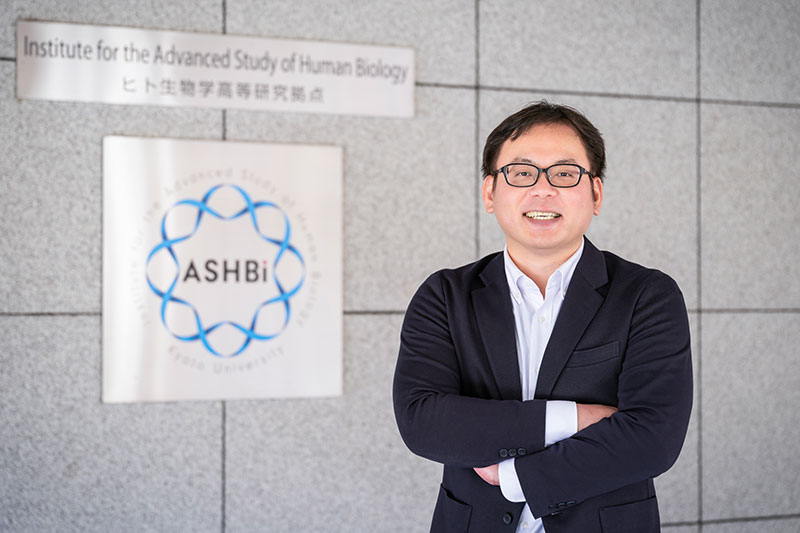
YAMAGUCHI Reona, assistant professor at the Institute for the Advanced Study of Human Biology (WPI-ASHBi).
Focusing on the Balance of “Excitation” and “Inhibition” in the Brain during the Recovery Process
When we move our bodies, commands are generated in the brain, transmitted through the spinal cord, and delivered to the muscles by motor neurons. When the spinal cord is damaged, these signals are not properly relayed, and motor function may be impaired. If the damage is mild, motor function can often be recovered through rehabilitation. Severe damage, however, is extremely difficult to overcome.
Yamaguchi has investigated the factors that hinder motor function recovery in cases of severe spinal cord injury, while also studying recovery mechanisms with the aim of achieving higher levels of functional restoration.
Research conducted on primates, in this case macaque monkeys with fine hand-movement mechanisms akin to those of humans, indicates that after severe spinal cord injury, electrical stimulation of the brain can increase activity in bilateral motor-related areas and induce the formation of previously unused neural circuits, thereby promoting functional recovery. “Very little was known about this until recently,” Yamaguchi says.
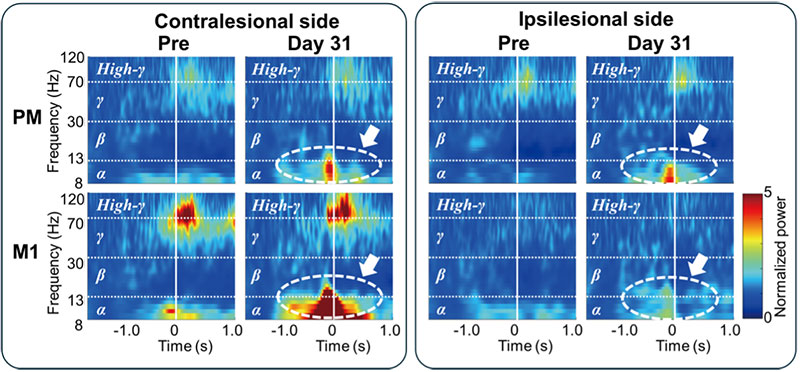
Images indicating changes in neural activity during the recovery process after spinal cord injury.
Yamaguchi probed further into the causes of excessive brain excitation during the recovery phase, focusing on the functional balance between excitatory and inhibitory connectivity. To do so, he applied LiNGAM (Linear Non-Gaussian Acyclic Model), a method typically used in the mathematical sciences, instead of the Granger causality tests commonly employed in analyses of electrical brain signals. This approach allowed him to evaluate the relationship between excitatory and inhibitory connectivity in the brain—a relationship that had previously been difficult to disentangle.
His analysis revealed that, in the early stages of motor function recovery, relative overexcitation in the brain was caused not by an increase in excitatory connectivity, but by a decrease in inhibitory connectivity.
“Until now, no one had examined the balance between excitatory and inhibitory connectivity in relation to functional recovery across broad brain regions,” Yamaguchi explains. “We developed experimental techniques that allowed us to selectively control specific neural circuits, and through this we succeeded in demonstrating the validity of these causal relationships. We consider this to be a significant achievement,” he adds.
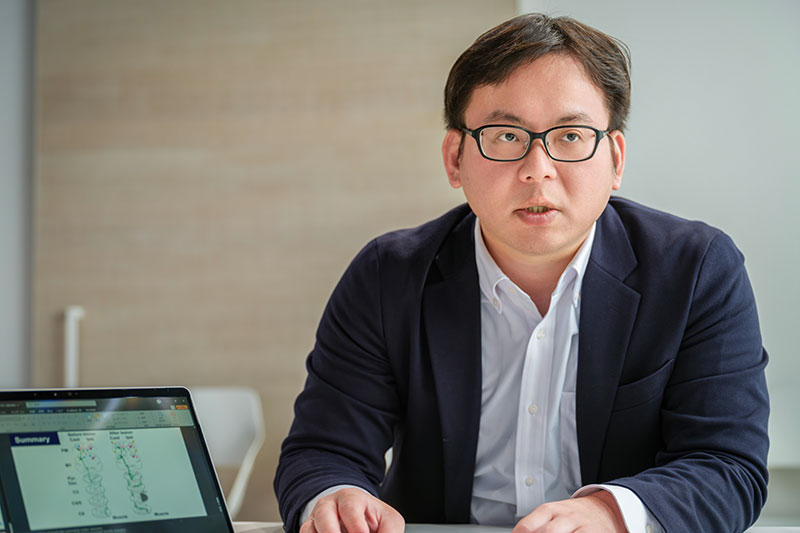
Yamaguchi has been with WPI-ASHBi since its founding as a member of the Isa Group, led by ISA Tadashi.
An Environment that Enables High-level Fusion Research
WPI-ASHBi as an institution aims to build a foundation for innovative medical development through interdisciplinary research that integrates the life sciences, mathematical sciences, and the humanities. The center’s objective is to clarify the principles underlying the acquisition of human characteristics and to shed light on the mechanisms whose failure leads to disease.
The ASHBi Fusion Grant Program is a major factor enabling innovative research such as Yamaguchi’s. It supports young researchers engaged in cutting-edge interdisciplinary research projects—particularly collaborations between mathematics and biology, bioethics and biology, and even between different subfields within biology itself. Yamaguchi’s project was selected for the program in FY2021, together with mathematical science researcher IMOTO Yusuke, also a member of WPI-ASHBi.
Experiments involving macaques are costly, due to high costs of animal care and the need for specialized equipment. Electrodes for monitoring high-density brain activity are also essential, as are computational resources to analyze vast amounts of data. Maintaining a challenging project of this scale requires significant financial resources. It was this special program that enabled a young researcher like Yamaguchi to secure sufficient funding and work in a flexible research environment.
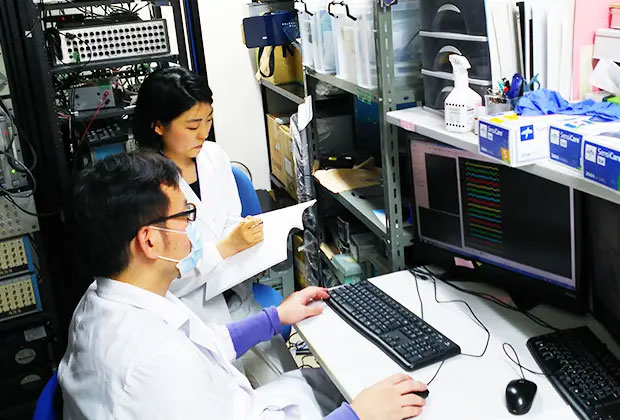
Yamaguchi working in the laboratory.
The “Under One Roof” environment promoted by WPI was another key factor that made it possible to pursue a fusion project with researchers from fields such as the mathematical sciences. “I realized how essential it is to be in an environment where we can work in the same building—discussing ideas thoroughly, engaging in repeated debate, and deepening our mutual understanding,” Yamaguchi says. He adds that this environment at WPI-ASHBi allowed the team to focus, during the first year of the project, on building a shared vocabulary with colleagues from other disciplines, enabling everyone to exchange research details with a common understanding.
Beyond providing funding, the grant program also offers close feedback throughout the review process and ongoing mentoring after selection, helping early-career researchers think through how to incorporate fusion research into their work. This support helps young researchers refine their initial ideas into well-defined, long-term research plans, providing valuable training in the acquisition of external funding and research project management skills essential for their future careers as PIs.
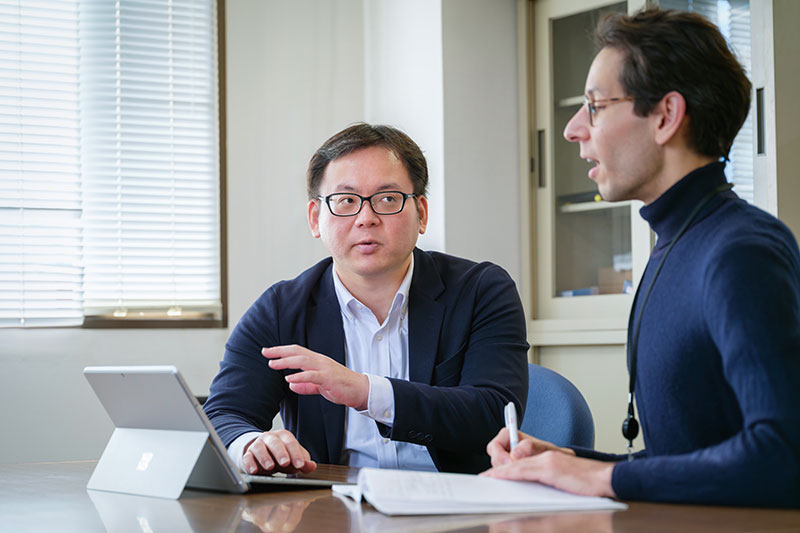
Yamaguchi in discussion with a fellow researcher in the lab. WPI-ASHBi provides an environment that encourages spontaneous communication across disciplines.
WPI-ASHBi also runs a number of Flagship Projects that promote high-level fusion research through close cooperation and exchange among different PI groups. Yamaguchi plays an active role in one such project.
“We don’t just analyze information transmission inside the brain. We also collaborate with genetic researchers to identify gene networks associated with functional recovery,” Yamaguchi says. “This kind of work makes it possible to pursue approaches that could not emerge from neuroscience alone, and the environment that enables such wide-ranging interdisciplinary fusion research is one of WPI-ASHBi’s great strengths.”

The open lounge at WPI-ASHBi, where free and open discussions take place across disciplines.
Linking Fundamental Research to Future Clinical Applications
Yamaguchi originally trained in engineering before pursuing his current career as a research scientist, and he has also spent time studying abroad. During his time in a research environment in the United States, he was struck by the scale of research budgets and the degree of autonomy afforded to researchers. At the same time, he became aware of the demanding reality that the continuation of research is often closely tied to success in securing competitive grant funding.
After joining WPI-ASHBi, he found satisfaction in an environment that enables both a high degree of research autonomy and the sustainability needed to pursue long-term projects. “What I realized here,” he says, “is that it is important to become truly strong in one’s own field, while also being able to move into other fields without hesitation.” He sees WPI-ASHBi as a place that naturally supports researchers in stepping beyond their own disciplines.
Yamaguchi aspires not only to clarify fundamental mechanisms, but also to translate his findings into future treatments. He speaks with quiet determination about building pathways toward clinical application, supported by the research environment at WPI-ASHBi.
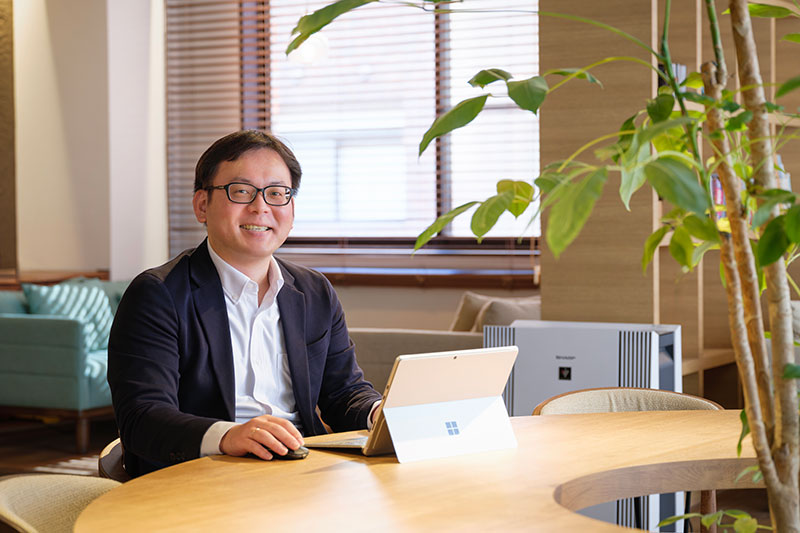
YAMAGUCHI Reona
Ph.D. in Systems and Information Science, Kagoshima University (2016)Senior Fellow, Washington National Primate Research Center, Department of Physiology and Biophysics, University of Washington (2016–2017)
Project-specific Assistant Professor, Department of Neurobiology, Graduate School of Medicine, Kyoto University (2017–2019)
Project-specific Assistant Professor, WPI-ASHBi, Kyoto University (2019–2024)
Assistant Professor, Department of Neurobiology, Graduate School of Medicine, Kyoto University (2024–)
Assistant Professor, WPI-ASHBi, Kyoto University (2024–)