
- HOME
- Careers
- Researchers' Voices
- Curiosity and Collaboration Unlock Secrets of the Human Immune System:
James Wing at WPI-IFReC
Curiosity and Collaboration Unlock Secrets of the Human Immune System:
James Wing at WPI-IFReC
May 26, 2026
Curiosity and Collaboration Unlock Secrets of the Human Immune System: James Wing at WPI-IFReC
Note: Interviewed in January 2026. Positions and titles are current as of the time of the interview..
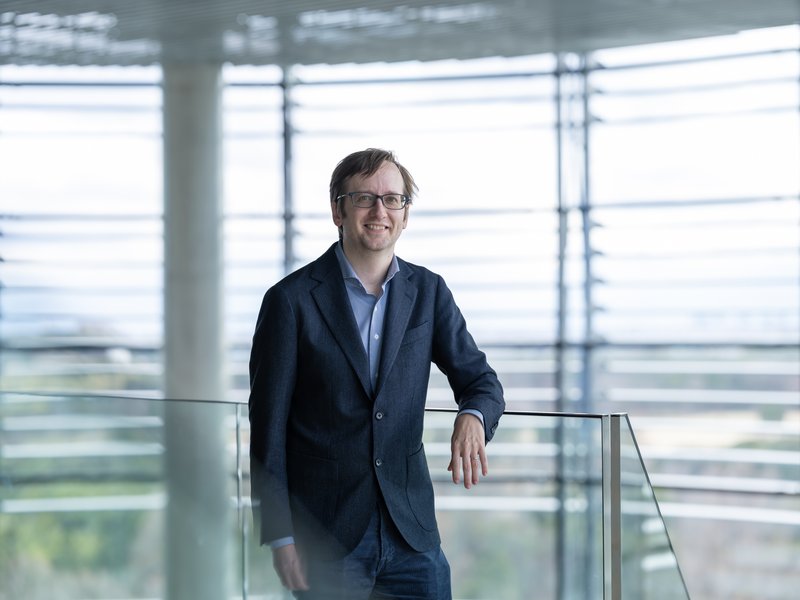
James Wing, PI at the Center for Infectious Disease Education and Research (CiDER) and Immunology Frontier Research Center (WPI-IFReC), the University of Osaka.
The Email that Launched a Research Program
Wing’s research at WPI-IFReC has primarily been focused on the interaction between regulatory T cells (Treg) and antibody-producing B cells. In fact, it was a desire to work with SAKAGUCHI Shimon, who later won a 2025 Nobel Prize in Physiology or Medicine for his discovery and description of Tregs, that first brought him to WPI-IFReC.
In his Ph.D. and postdoctoral work at the University of Sheffield, Wing studied interactions between bacteria and the innate immune system. This sparked an interest in the immune system’s inner workings. “It was clear at that time that B cells, which are responsible for producing antibodies, were controlled by Tregs, but we didn’t really understand the details,” he says. “So I emailed Professor Sakaguchi to propose a research project, and that led to me coming over to join his group at WPI-IFReC.”
A New Institution with World-Class Talent
Wing arrived as a JSPS International Research Fellow. At that time, WPI-IFReC was still so new that some facilities were still under construction. “The center hadn’t yet established an independent reputation, but it had already recruited many world-famous immunologists, such as Professor Sakaguchi, Professor KISHIMOTO Tadamitsu, and Professor AKIRA Shizuo, who served as its director. I was confident that it would be a good place to move to.”
Wing spent his first decade at WPI-IFReC in Sakaguchi’s lab, identifying and studying special types of Tregs called T follicular regulatory cells. “Broadly speaking, you need B cells to produce antibodies to protect you from viruses and bacteria, but you also need Tregs to keep them from going off topic, so to speak, and producing antibodies that attack your own body.”
In 2019, Wing became a PI, leading his own laboratory in research that was more focused on infectious diseases specifically. “For example, in September we published a paper about what happens to Tregs during severe COVID-19,” he says. “We found that the infection disrupts T follicular regulatory cell precursors—the earliest form of the cell, before they are fully differentiated—which may be one of the reasons you see autoantibody production in those cases.”
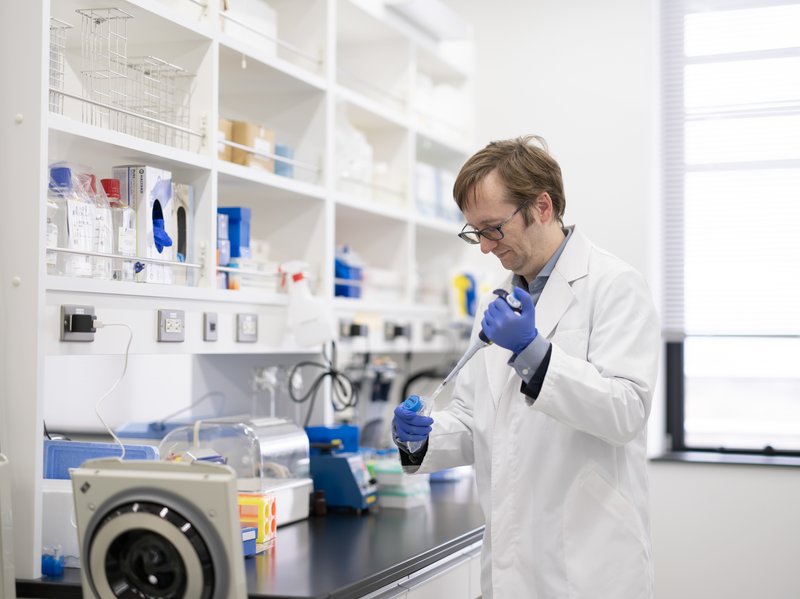
WPI-IFReC’s “Advanced Postdoc System” gives promising postdoctoral researchers a three-year position to pursue their work, including research fees and autonomy equivalent to an assistant professor. Several members of Wing’s laboratory are Advanced Postdoc System researchers.
Administrative Support Lets Researchers Focus on Work
Wing found WPI-IFReC’s administrative staff extremely helpful in getting up and running as a researcher in Japan. “They helped me with immigration procedures even before I arrived,” he says. “Once I was here, they helped me set up a bank account and handle other necessities of daily life.”
The English working environment of WPI-IFReC also helped Wing become productive immediately—but he also appreciated the weekly Japanese lessons that began being offered free to members a few years after his arrival.
A Collaborative Environment with Real Career Opportunities
Above all, Wing says, it is the people who make WPI-IFReC special. “It was great to have world-class Treg and B cell people in the same building. Professor Sakaguchi is obviously the Treg expert, but the next lab over, literally, was run by Professor KUROSAKI Tomohiro, a B cell expert. We also had Professor ISE Wataru, who is now also at CiDER. On the first paper I published, I was the first author, Professor Sakaguchi was the last author, and the other two authors were Professors Ise and Kurosaki. Since it was a paper about Tregs and B cells it was very important to me to receive help from Treg and B cell experts.”
The culture at WPI-IFReC fosters a non-hierarchical environment, allowing even new researchers to readily seek advice from experienced mentors. There are also regular colloquia with presentations and social events. “Once you know what people do, you can go to them for help on particular issues,” says Wing. “Collaborations arise organically, making you more productive.”
The presence of non-Japanese PIs was also heartening. “Almost every postdoc hopes to be a PI one day, so it was good to see that that route is open at WPI-IFReC.”
WPI-IFReC also offered extensive equipment and budgetary support. “We basically had everything we needed for research, and if we required additional resources, they were usually obtainable. The single-cell techniques I began to specialize in used an instrument called a mass cytometer. It’s a big, expensive machine, costing on the order of 100 million yen. When I explained the need for it, WPI-IFReC procured one. That was another important kind of career support.”
In more recent years, Wing says, WPI-IFReC has launched a “single-cell support program,” in which labs are assigned a budget for performing single-cell sequencing centrally. “That makes life much easier, because otherwise that work is very expensive to do.”
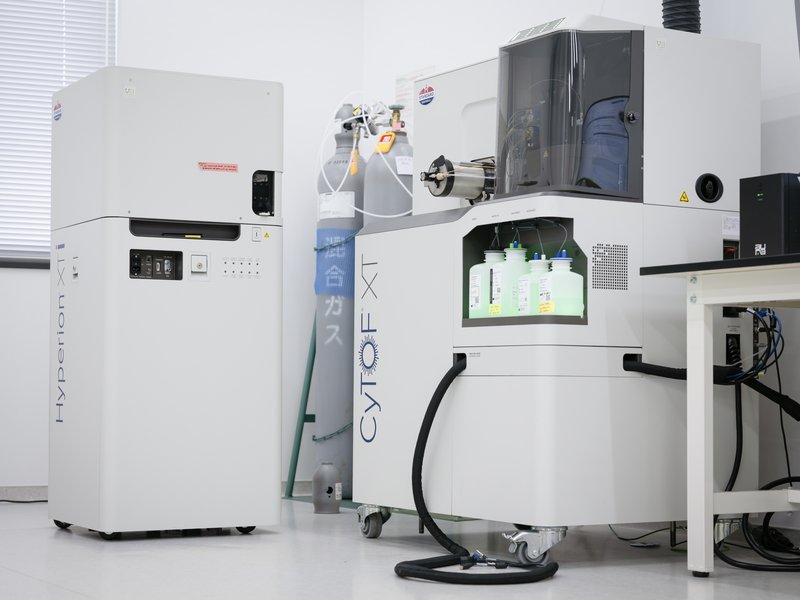
The mass cytometer installed at Wing’s request.
The Next Twenty or Thirty Years
Wing is now a tenured professor at the University of Osaka, the PI of a laboratory attached to CiDER, and a PI at WPI-IFReC. “We have the facilities, the space, the budget, and an outstanding team of researchers, so I’m thinking about what research to do next, rather than where to go next,” he laughs.
His immediate goal is to find clinical and medical applications for the basic science done so far on Treg and B cells. “Professor Kishimoto at WPI-IFReC completed the full journey of discovering interleukin-6 and then making a drug from it. We recently discovered some new types of Tregs and B cells, and I’d like to make a similar journey over the next twenty, thirty years.”
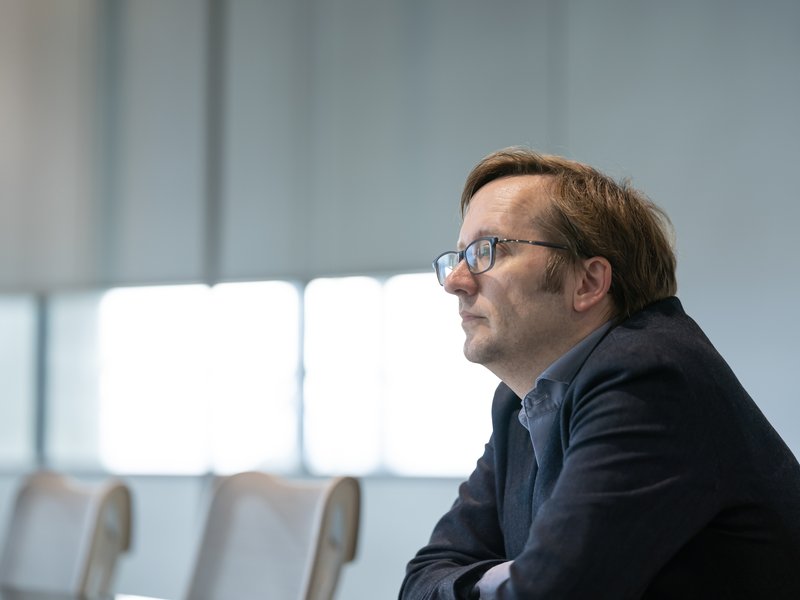
“At this point, I’m basically here at WPI-IFReC for maybe forever,” says Wing.
Wing’s advice for early career researchers considering a position at WPI-IFReC is, he says, really applicable to research anywhere. “You need to be self-motivated, developing your own research questions and maintaining independence of thought,” he says. “At the same time, this should be balanced with recognition that, as a young scientist, you have a lot to learn from those more senior to you.”
Cultural flexibility is also important, Wing says. “That said, there’s more person-to-person variation within a given culture than there is culture-to-culture variation. It’s really a matter of finding the people you get along with. You need to join a group you want to work with! As a researcher, I’m driven by curiosity, and WPI-IFReC has been a wonderful and supportive place for pursuing that alongside talented colleagues.”
James Wing
B.Sc. in Microbiology, University of Surrey, Guildford (2003)Ph.D. in Infection and Immunity, The University of Sheffield Medical School, Sheffield (2008)
Post-Doctoral Research Associate, Department of Infection and Immunity, University of Sheffield Medical School, Sheffield (2008–2010)
JSPS International Research Fellow, Experimental Immunology Lab, WPI-IFReC, The University of Osaka (2010–2012)
Assistant Professor, Experimental Immunology Lab, WPI-IFReC, The University of Osaka (2012–2017)
Associate Professor, Experimental Immunology Lab, WPI-IFReC, The University of Osaka (2017–2019)
Associate Professor (PI), Human Immunology Lab, WPI-IFReC, The University of Osaka (2019–)
Associate Professor (PI), Human Immunology Team, CiDER, The University of Osaka (2021–2024)
Professor (PI), Human Immunology Team, CiDER, The University of Osaka (2024–)