
- HOME
- Careers
- Researchers' Voices
- Engineering Sustainable Futures through Computational Materials Design in a Research Environment that Fosters Growth: Kulbir Kaur Ghuman at WPI-I²CNER
Engineering Sustainable Futures through Computational Materials Design in a Research Environment that Fosters Growth: Kulbir Kaur Ghuman at WPI-I²CNER
May 12, 2026
Engineering Sustainable Futures through Computational Materials Design in a Research Environment that Fosters Growth: Kulbir Kaur Ghuman at WPI-I²CNER
Kulbir Kaur Ghuman is a computational materials scientist working to develop sustainable materials that form the foundation of technologies aimed at addressing climate change. Now an Associate Professor at the Institut national de la recherche scientifique (INRS) and holder of a Tier 2 Canada Research Chair in computational materials design for energy and environmental applications, and Quebec Chair for Inclusion in Science and Engineering, she credits her time at the International Institute for Carbon-Neutral Energy Research (WPI-I²CNER) at Kyushu University as a transformative period that helped her grow into a truly independent researcher.
Ghuman spoke to us about how the interdisciplinary environment of the WPI program shaped her career and strengthened her commitment to tackling climate change at the atomic level.
Note: Interviewed in January 2026. Positions and titles are current as of the time of the interview.
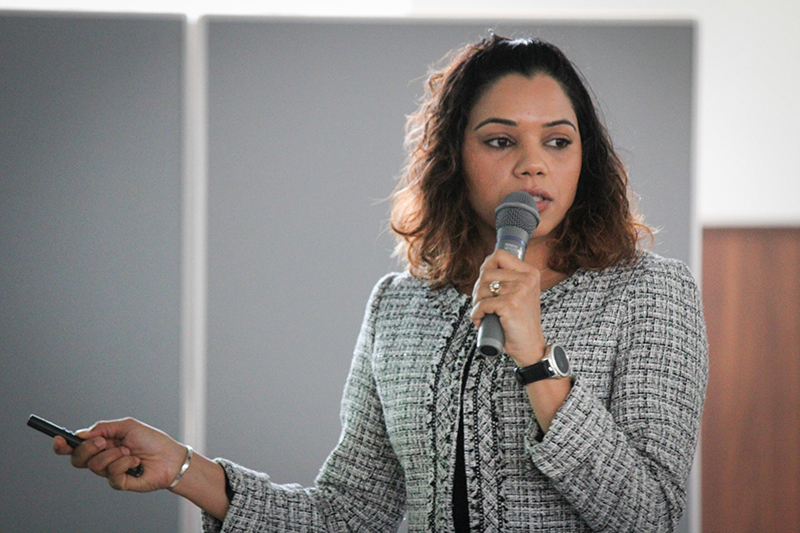
Kulbir Kaur Ghuman, formerly a researcher at the International Institute for Carbon-Neutral Energy Research (WPI-I²CNER), now serves as an Associate Professor at the Institut national de la recherche scientifique (INRS) in Canada.
Engineering Atomic-Scale Materials for a Low-Carbon Future
Ghuman explores materials at the atomic scale to help address one of the greatest challenges facing humanity: climate change. Her research focuses on developing materials that support a wide range of sustainable technologies designed to enable a low-carbon energy future.
From fuel cells and lithium-ion batteries to green ammonia synthesis, hydrogen production, CO₂ reduction and conversion, and carbon capture, these technologies all depend on sustainable materials as their foundation. Ghuman aims to replace rare and costly materials with abundant, affordable alternatives, while improving performance by understanding and harnessing structural defects and disorder present in materials at the atomic and electron level.
“Materials that are efficient, cost-effective, and safe are urgently needed,” says Ghuman. “I work on designing and developing such materials using computational materials science tools. It is highly interdisciplinary, drawing on physics-based and chemistry-based approaches, as well as mathematics, AI, engineering, and related fields.”
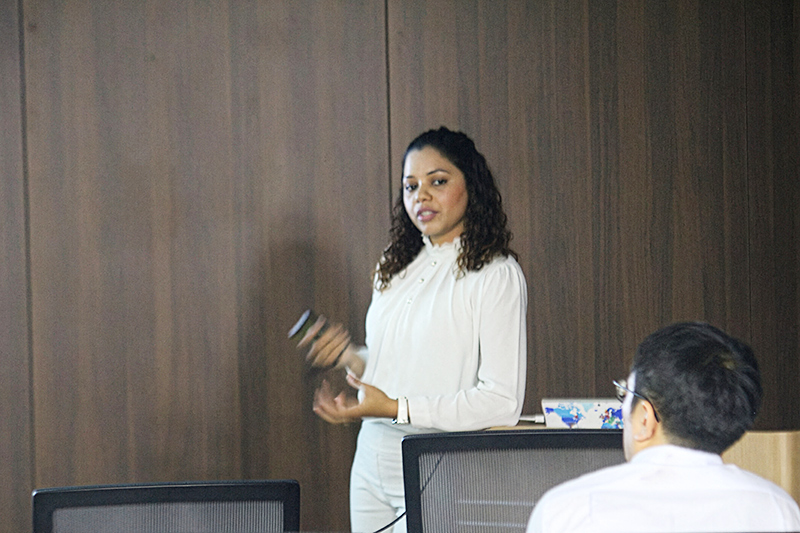
Ghuman presenting her research at a symposium.
Navigating Cultural and Career Barriers through Interdisciplinary Science
Born and educated in India, Ghuman chose physics, computer science, and mathematics early on, drawn to the elegance of fundamental laws. During her Ph.D. in condensed matter physics, a three-month stay in Canada in 2011 proved to be a turning point. What began as a short visit quickly turned into a formative research experience at the University of Toronto, where she encountered interdisciplinary science for the first time.
“That was the turning point in my career,” she recalls. Spending several years in Canada both as an international visiting researcher and, after completing her doctorate, a postdoctoral researcher working with Materials Science and Engineering Professor Chandra Veer Singh and Chemistry Professor Geoffrey Alan Ozin, Ghuman faced a familiar crossroads for many early-career scientists: how to continue expanding her research opportunities and academic growth.
“In Canada, for example, the academic job market has not kept pace with the number of Ph.D. graduates. Only about one in five Canadian Ph.D. holders secure a tenure track position in their field,” she says.
“Yet the other academic research professional careers (such as research associate, lab manager, group leader, etc.) are not very well recognized or promoted in Canada. Furthermore, being a woman makes it even harder. Structural barriers and societal expectations also play a role—particularly in countries like India, where I grew up, women are often expected to prioritize marriage and family. This can create additional pressure on an already demanding and financially uncertain research journey.”
It was during this period that she came across a position at WPI-I²CNER, almost by chance. Established in 2010 under the WPI program and hosted by Kyushu University, WPI-I²CNER focuses on advancing low-carbon, energy-efficient, and cost-effective energy systems and technologies. When she read about the institute’s goals and found that they aligned closely with her own, she decided to apply through an online advertisement.
“WPI-I²CNER’s mission is to develop energy technologies that are sustainable, energy-efficient, and cost-effective,” she says. “That was very closely aligned with the focus of my own research.”
Japan’s research infrastructure was another decisive factor. “My research needs a strong computational and experimental infrastructure,” Ghuman explains. At WPI-I²CNER, theory and experiment were not siloed. Advanced techniques such as low-energy ion scattering (LEIS) allowed researchers to probe surface atomic layers directly, an ideal match for computational work. “It created an environment where theory, computation, and experiment could truly work together.”
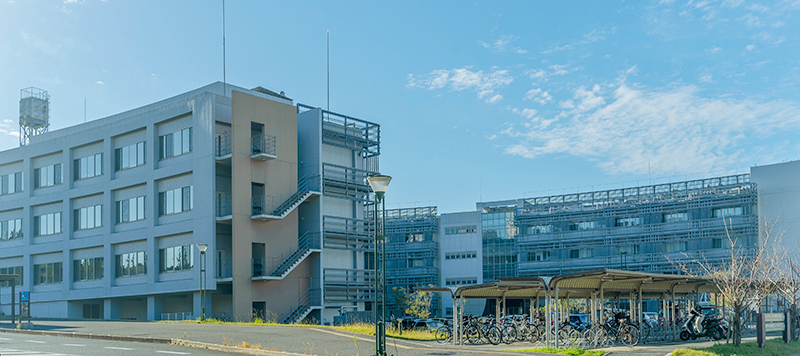
WPI-I²CNER consists of two large research buildings and is the world’s first research institute to bear the name “carbon-neutral.”
(Photo: WPI-I²CNER)
Growing into True Independence in a World-Class Research Environment
Upon arriving at WPI-I²CNER in Fukuoka, southern Japan, Ghuman found herself immersed in a uniquely international environment.
“When I arrived at WPI-I²CNER, it happened to coincide with the center’s annual symposium Energy Week,” she recalls. “During that event I had the opportunity to meet leading researchers not only from Japan, but also from institutions such as MIT (Massachusetts Institute of Technology), Imperial College London, PSI (Paul Scherrer Institute), and ETH Zurich. It was fascinating,” she says.
The encounter was not limited to special events. “All these exceptional leading researchers in our field were based at WPI-I²CNER, and they were available to discuss your research with you one-on-one. That was incredibly helpful and appealing.”
Her research portfolio expanded rapidly. At WPI-I²CNER, she began working on solid oxide fuel cells, polymer electrolyte membrane fuel cells, and ammonia synthesis—fields she had not previously explored in depth.
“After coming to WPI-I²CNER, I started working on entirely new, different topics, still aligned with my broader goal of advancing carbon-neutral energy research,” she says. “My research vision expanded significantly. I truly became an independent researcher.”
Equally important was the center’s support beyond the laboratory. Even though she was in a completely new cultural and research environment, Ghuman found the transition from Canada to Japan unexpectedly smooth.
“I didn’t feel many barriers when I arrived, to my surprise,” she says. Administrative staff helped with everything from paperwork to daily logistics, allowing her to focus fully on research. “Professionally, as well as personally, integrating into life in Japan felt utterly seamless.”
Ghuman’s affection for Japan runs deep. “I think that was one of the most amazing times in my life—the culture, the people, everything,” she says. She and her husband even gave their son a Japanese name, Mitchi, meaning “path” or “way,” a lasting reminder of their time in Fukuoka.
From Fukuoka to Global Leadership: The Lasting Impact of the WPI Model
After nearly three years at WPI-I²CNER, Ghuman attended a conference in Cape Town, South Africa, where a senior professor, Mohamed Chaker, from INRS encouraged her to apply for a professorship there. She returned to Canada in 2019 and joined the INRS Énergie Matériaux Télécommunications Research Centre located in Varennes, just outside of Montreal, Quebec’s largest city. She credits her experience in WPI-I²CNER with opening doors.
“Many countries place considerable value on the international experience in Japan—not only because of the international research environment, but also because of the distinct approaches to conducting research that one learns there. WPI-I²CNER, like many leading institutes in Japan, has a strong international reputation, and that recognition—together with the research expertise and experience I gained at WPI-I2CNER—played an important role in my invitation to join INRS as a professor. It was a remarkable coincidence that it all happened during that conference.”
Yet Ghuman’s connection to WPI-I²CNER has never truly ended. Collaborations continue, as do student exchanges and joint symposia linking Canada and Japan. Several former WPI-I²CNER students and researchers are now part of her team at INRS, and she has helped build new international research networks inspired directly by the WPI model. “I feel like I never left WPI-I²CNER,” she says.
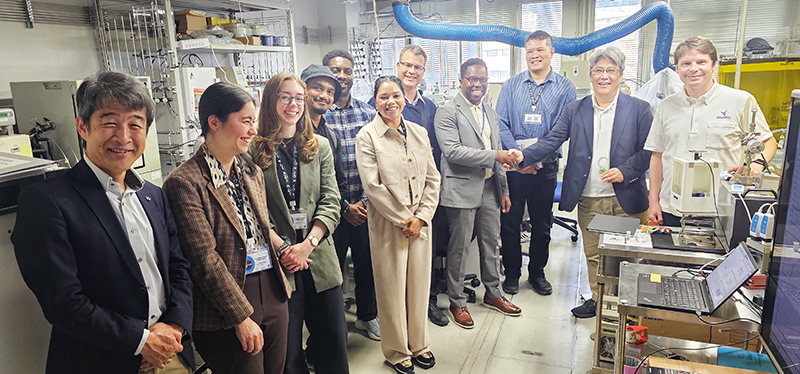
Guided tour during the 3rd Computational Energy Materials Design Infrastructure (CEMDI)-Perspective of Artificial Intelligence in Materials Science (PAIMS) Symposium 2025 held at WPI-I²CNER. Global leaders in AI and materials science attended from Canada and Japan. Ghuman, standing at the center in a beige suit, is not only the organizer of this biannual symposium—held alternately in Japan and Canada—but also the founder of CEMDI, whose mission includes fostering international partnerships to develop sustainable energy technologies and combat climate change.
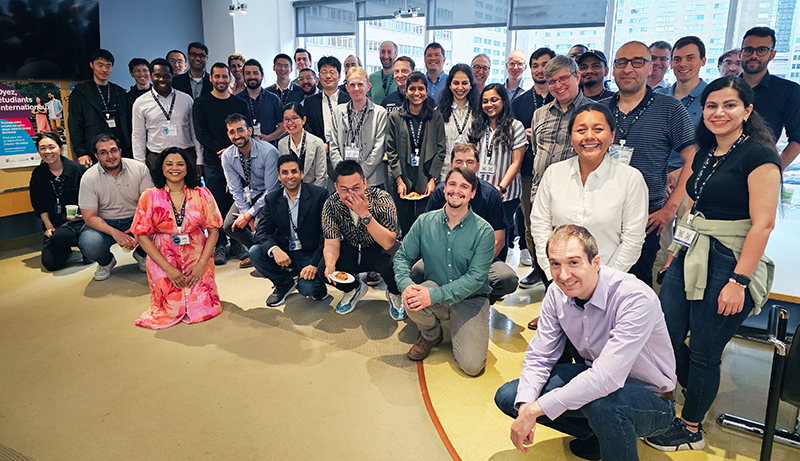
The 2nd CEMDI-PAIMS Symposium, held at INRS in 2024. Many researchers from Japan, including those from WPI-I²CNER, participated.
Looking back, Ghuman sees WPI-I²CNER as emblematic of what the WPI program can offer early-career scientists. “WPI-I²CNER provides a world-class research environment,” she says. “They have the infrastructure, exceptional administrative support, and an international community that you truly become part of.”
For researchers considering a WPI center, her advice is clear: “If you’re lucky enough to be at one of these centers, you should absolutely seize that opportunity. They can really help shape your career, as they have done for me.”
Kulbir Kaur Ghuman
Ph.D. in Condensed Matter Physics, Panjab University (2013)International Visiting Researcher / Postdoctoral Fellow, University of Toronto (2012–2015)
Research Associate, University of Toronto (2015–2016)
WPI Postdoctoral Research Associate, WPI-I²CNER, Kyushu University (2017–2019)
Guest WPI Researcher, Paul Scherrer Institute (2017–2019)
Assistant Professor, INRS-EMT (2019–2024)
Associate Professor, INRS-EMT (2024–)