
- HOME
- Careers
- Researchers' Voices
- Cutting-Edge Science on Historical Premises: Tengyi Liu at WPI-AIMR
Cutting-Edge Science on Historical Premises: Tengyi Liu at WPI-AIMR
Apr 30, 2026
Cutting-Edge Science on Historical Premises: Tengyi Liu at WPI-AIMR
Tengyi Liu is a Specially Appointed Assistant Professor at the Advanced Institute for Materials Research (WPI-AIMR), Tohoku University. With access to facilities like XRD, Raman, and SEM combined with mentorship and support for everything from securing grants to finding apartments, WPI-AIMR helps Liu focus on his research into turning carbon dioxide into more useful compounds like methane using electrocatalytic reduction—one potential tool for building decarbonized societies. Liu spoke to us about why he sought out his position at WPI-AIMR and the support he found there as an early-career researcher.
Note: Interviewed in January 2026. Positions and titles are current as of the time of the interview.
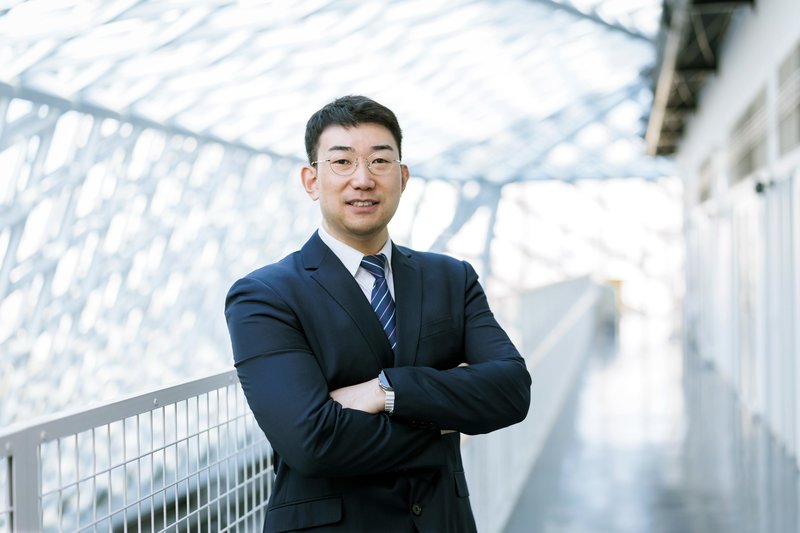
Tengyi Liu, a Specially Appointed Assistant Professor at the Advanced Institute for Materials Research (WPI-AIMR), Tohoku University.
Sights Set on WPI-AIMR for Professional and Personal Reasons
Electrocatalytic reduction of carbon dioxide, or “CO2RR,” converts carbon dioxide into compounds such as carbon monoxide and methane, which have applications for fuel and other purposes. If applied to atmospheric carbon dioxide, this could help in humanity’s ongoing efforts to decarbonize societies and halt or even reverse global warming. To make CO2RR practical for these applications, new techniques and materials will be required. This is the focus of Liu’s research in YABU Hiroshi’s laboratory at WPI-AIMR, Tohoku University.
Liu came to WPI-AIMR in 2023, after two years as a postdoctoral researcher at the University of Osaka’s Research Center for Solar Energy Chemistry (RCSEC). Entering a WPI center was a specific goal of his at that point. “I knew that WPI centers aim to give scientists the stability and freedom to pursue world-leading research, with strong, long-term support at the national level,” says Liu. “Obviously, that matched my career goals very strongly.”
Personal reasons also drew Liu to WPI-AIMR. As a student in China, one of his most passionate and exciting teachers was a graduate of Tohoku University, and always spoke highly of it. Liu also felt a special connection to iconic Chinese writer Lu Xun (1881–1936), who was a student at the institution as well. “Lu Xun’s ideas influenced generations,” says Liu. “Knowing that Lu Xun once studied and lived at Tohoku University gave the place a strong historical and emotional meaning for me.”
Liu applied for a position being advertised by Yabu Laboratory at WPI-AIMR. Over several rounds of interviews, it became clear that Liu’s work on CO2RR would complement the research being done by Yabu’s group, and Liu joined the lab as a Specially Appointed Assistant Professor.
Everything Needed to Grow as a Researcher and a Leader
Liu found his post at WPI-AIMR ideal for building his career. “At a basic level, the competitive salary and affordable faculty housing ensure peace of mind and let me fully concentrate on my research,” he says. WPI-AIMR also encourages early-career researchers to apply for external grants, such as Grants-in-Aid for Scientific Research (KAKENHI), and Liu has successfully secured such funding. The institute also has a shared instrumentation center, Common Equipment Room, that removes other practical barriers to research. “Facilities like XRD, Raman, and SEM are freely available to early-career researchers like me, and professional staff provide training and technical support.”
The Yabu laboratory in particular, Liu says, allowed him to thrive. “Professor Yabu has given me great trust and encouragement, helped arrange experimental space, and supported access to testing facilities,” he says. “With his support and guidance, I set up a complete experimental system with a full CO2RR workflow, from CO2 supply and collection to product analysis. He’s also very friendly and approachable, which makes day-to-day research run more smoothly.” In 2025, Liu and Yabu’s work on biomass electrode catalysts was featured as a research highlight, recognizing it as an outstanding example of research at the center.
Last year, Liu and Yabu jointly recruited and supervised a postdoctoral researcher. “I shifted from being an independent researcher to leading a small team,” says Liu. “This improved efficiency and diversity of thinking, and also helped me grow in terms of decision-making and leadership.”
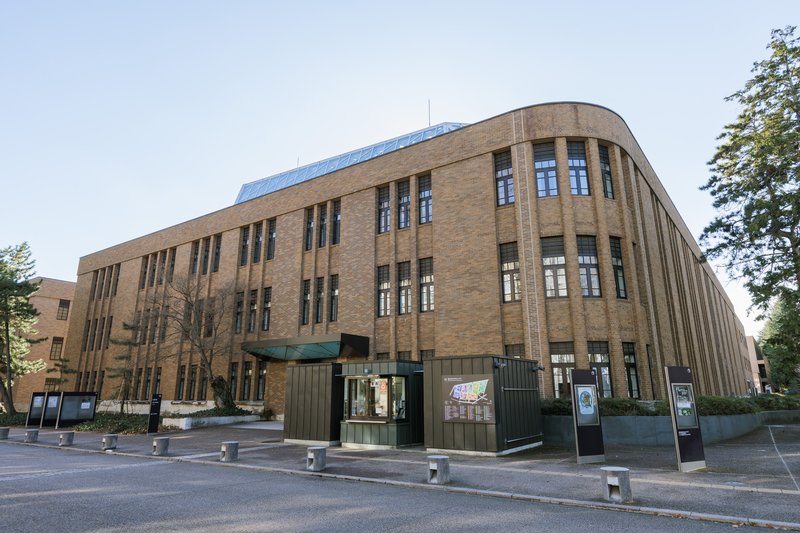
The WPI-AIMR Main Building preserves the exterior of the university building that stood on its site since 1925, while having been fully modernized inside to serve as a state-of-the-art research facility.
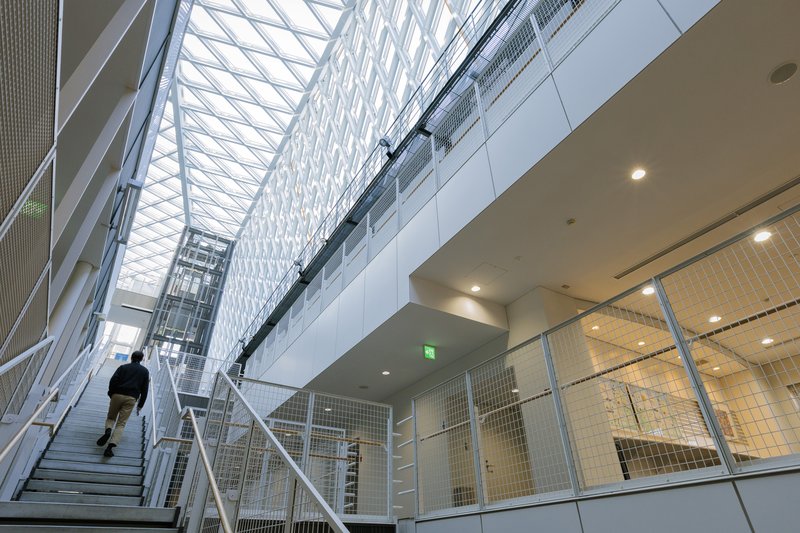
The atrium of the WPI-AIMR Main Building is spacious and brightly lit with natural light, encouraging serendipitous encounters between researchers.
Collaboration and Communication Bring Concrete Benefits
Like all WPI centers, WPI-AIMR aims to foster a high degree of communication and interdisciplinary collaboration. “Every Friday afternoon, we have ‘tea time,’ where researchers from different fields casually share ideas and discuss their progress,” says Liu. “To be honest, these feel like the discussion sessions at an international conference, and often lead directly to improvements in research. For instance, after chatting with Professor Hao Li at one tea time, I added density functional theory (DFT) calculations to one of my papers, significantly strengthening the argument.”
Collaboration is also fostered through more formal initiatives, such as WPI-AIMR’s “Fusion Research” projects. These bring together researchers from different backgrounds and often grow into competitive external grants. Liu’s current KAKENHI project, on developing high-efficiency ethylene manufacturing technology using hollow copper nanoparticles, is one example.
Meanwhile, WPI-AIMR’s annual conferences attract researchers from other universities and countries, creating chances for both interdisciplinary and international teamwork. “At one conference, I had a discussion with Professor YAMAUCHI Miho at WPI-I²CNER, Kyushu University, that led to us carrying out in-situ Raman measurements and expanding our characterization methods,” says Liu.
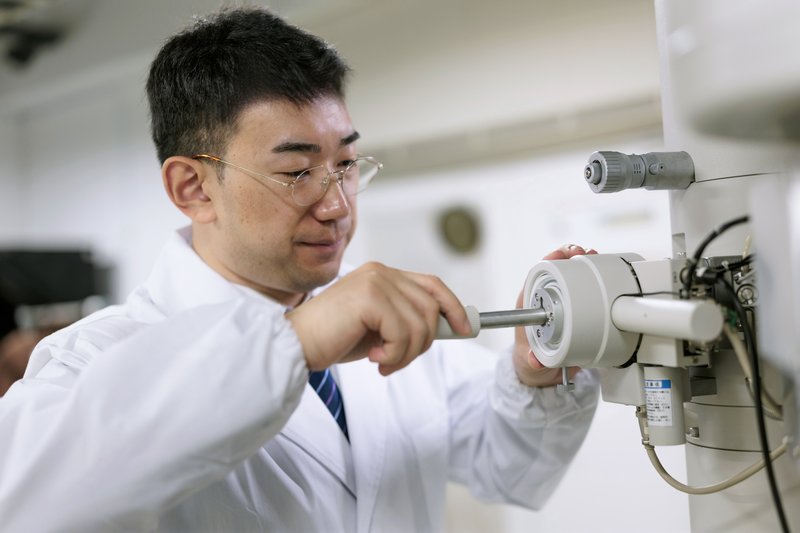
Liu adjusting a laboratory apparatus.
Academic Freedom with Administrative Support
Liu also enjoys the high degree of freedom accorded to researchers at WPI-AIMR in terms of research direction. “Our group specializes in molecular catalyst design and synthesis, so I’m free to explore how these catalysts apply to CO2RR, my particular field of expertise,” he says. “However, I’m also involved in topics shared by the whole group, like electrochemical water splitting. This gives me a broader perspective that often supplies new ideas for my own research.”
At the same time, WPI-AIMR offers extensive support that guides newcomers through complicated administrative tasks and eases the transition to a new country. “In my case, I had already been working in Japan for two years, and the cultural proximity to China made it relatively easy to adapt in any case,” says Liu. “However, our secretary here in Sendai was very helpful with all kinds of procedures, including renewing my residence card.”
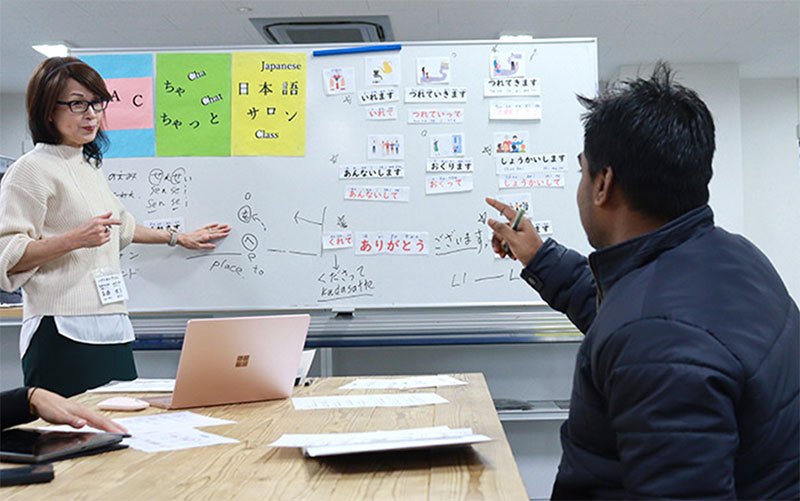
WPI-AIMR has an International Affairs Center to support international researchers. As well as support for administrative tasks before and after arrival, the center holds Japanese classes that researchers’ families are also welcome to join.
Asked for his message to other researchers considering WPI-AIMR, Liu offers a favorite Japanese phrase: “Ichigo ichie means treasuring each encounter because it only happens once in a lifetime. In research, many important ideas and breakthroughs are born from these one-time encounters. At WPI-AIMR, you have the chance to encounter world-class researchers from all over the world—China, India, Europe, the United States . . . The people you meet, the ideas you exchange, and the challenges you embrace here may shape your future path in ways you don’t expect. So do your best and go for it!”
Tengyi Liu
Ph.D. in Materials Science and Engineering, School of Materials Science and Engineering, Beihang University (2020)Postdoctoral Researcher, Research Center for Solar Energy Chemistry (RCSEC), Osaka University (2020–2023)
Specially Appointed Assistant Professor, WPI-AIMR, Tohoku University (2023–2026.3)
Liu began his career as a specially appointed senior assistant professor at WPI-AIMR in April 2026.