
- HOME
- Careers
- Researchers' Voices
- Behind the Scenes at WPI-QUP:
How Administrative Staff Build an Open and Flat Working Environment with Robust Support
Behind the Scenes at WPI-QUP:
How Administrative Staff Build an Open and Flat Working Environment with Robust Support
Apr 24, 2026
Behind the Scenes at WPI-QUP:
How Administrative Staff Build an Open and Flat Working Environment with Robust Support
Located in Northern Tsukuba is one of three WPI centers, noted for its collaborative environment: the International Center for Quantum-field Measurement Systems for Studies of the Universe and Particles (WPI-QUP), part of High Energy Accelerator Research Organization (KEK). At the heart of this welcoming atmosphere is the dedicated support of administrative staff, who work closely with researchers to meet their everyday needs. How was an environment created in which researchers can devote themselves fully to their research? This report takes you behind the scenes to find out.
Note: Interviewed in December 2025. Positions and titles are current as of the time of the interview.
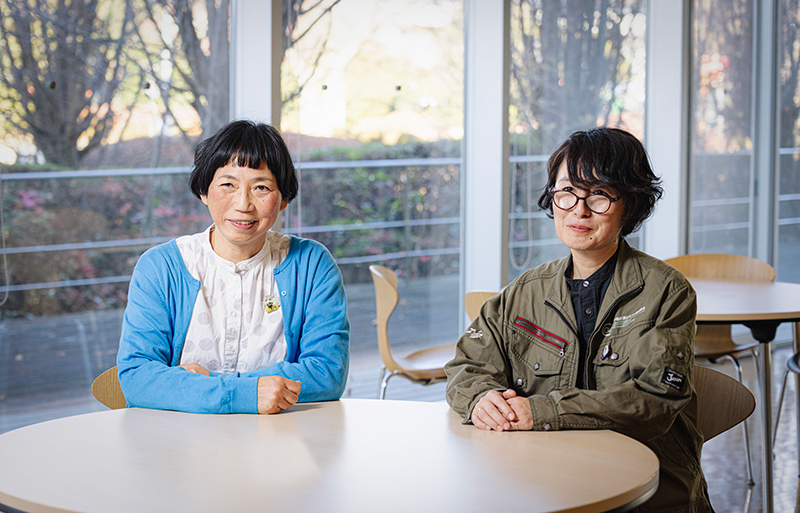
KOBAYASHI Nobue(left), administrative specialist, and IKENOBE Noriko, technical specialist, at the International Center for Quantum-field Measurement Systems for Studies of the Universe and Particles (WPI-QUP).
Researchers and Office Specialists Work in Unison
WPI-QUP is located in the City of Tsukuba, Ibaraki Prefecture. WPI-QUP, integrates astrophysics, quantum physics, and measurement science, with a mission to invent and develop new systems for measuring quantum fields. Since being designated a WPI center in December 2021, WPI-QUP has fostered an open environment that has become one of its most appealing features—thanks in large part to the efforts of its office specialists. Key contributors in creating this environment are IKENOBE Noriko and KOBAYASHI Nobue, who joined WPI-QUP in early 2022.
Before joining WPI-QUP as a member of the public relations staff upon its establishment, Ikenobe worked at a research center at the National Institute for Materials Science (NIMS) in an entirely different role. Taking on PR at WPI-QUP was a new challenge for her, and she set out to learn. To prepare, she made a point of visiting other WPI centers to learn from public relations teams and administrators how she could communicate more effectively with researchers.
“From other WPI centers, I learned that building trust with researchers is the most important first step. I feel that I have grown and matured together with WPI-QUP, and my goal is to be someone researchers can turn to first when they face difficulties,” Ikenobe recalls.
Like Ikenobe, Kobayashi has also been with the center since its start-up. A longtime administrator of Tsukuba’s WPI centers, she had previously worked at the Research Center for Materials Nanoarchitectonics (WPI-MANA) and the International Institute for Integrative Sleep Medicine (WPI-IIIS), making her the rare individual who has served at all three WPI centers in Tsukuba. At WPI-QUP, she works as an administrative specialist, with primary responsibilities in secretarial support and facilitating research activities in numerous ways—handling cumbersome paperwork on behalf of researchers, including logistics for international conferences, preparing security export control reviews, assisting with visa applications, arranging air travel, and so on.
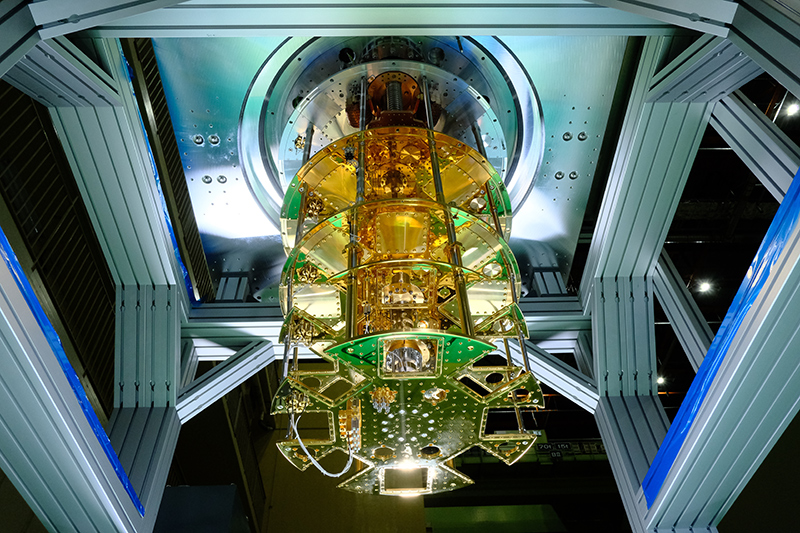
A dilution refrigerator at the Fuji Laboratory of WPI-QUP. This device is essential for advancing the QUP mission.
Local Tsukuba Snacks Bring Researchers Together
WPI-QUP frequently holds international conferences, and Ikenobe and Kobayashi have introduced a variety of initiatives, extending beyond the purely scientific program, to stimulate interaction and spark research discussions. For example, the “QUPosium,” held three times so far, has evolved with each iteration—such as increasing presentation opportunities through additional poster sessions combined with reception dinners or lunches. One feature that has emerged is hospitality reflecting Tsukuba’s regional flavors and culture.
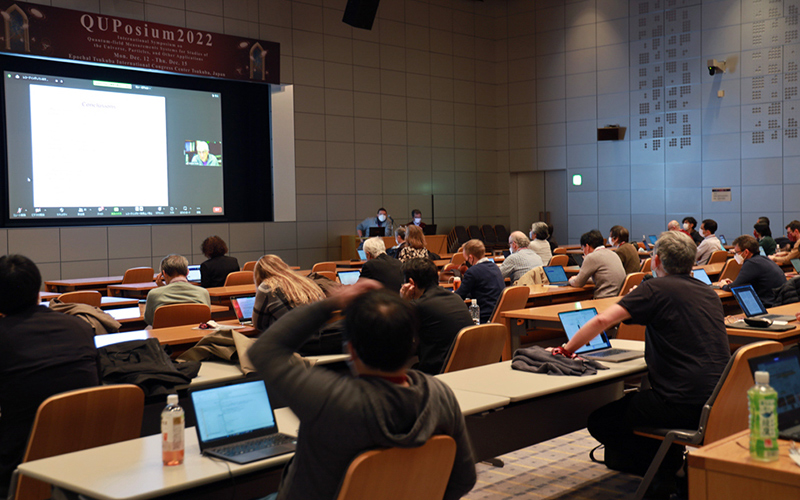
The first QUPosium held in 2022.
“During break time, we serve special regional treats from Tsukuba, such as sweets from famous local patisseries. While enjoying these snacks, conversations flow naturally, and researchers from different fields begin introducing their work to one another. These casual exchanges sometimes spark ongoing collaborations afterward,” explains Ikenobe.
The administrative staff themselves support these coffee breaks, mingling with researchers and actively facilitating connections. “If we notice someone standing alone or hesitating to approach others, we’ll gently—perhaps a bit proactively—introduce them to other researchers and help them join the conversation,” Kobayashi adds with a smile. This hands-on approach to fostering interactions has become an integral part of creating WPI-QUP’s collaborative atmosphere.
A research scientist at the center remarks of the administrative team: “Having experienced staff who speak English and are skilled at organizing conferences means we can confidently leave all aspects of conference management to them.” Another advantage for visiting scientists is that KEK houses multiple research facilities, including large-scale experimental devices such as accelerators, which can be toured and are especially appealing to international researchers.
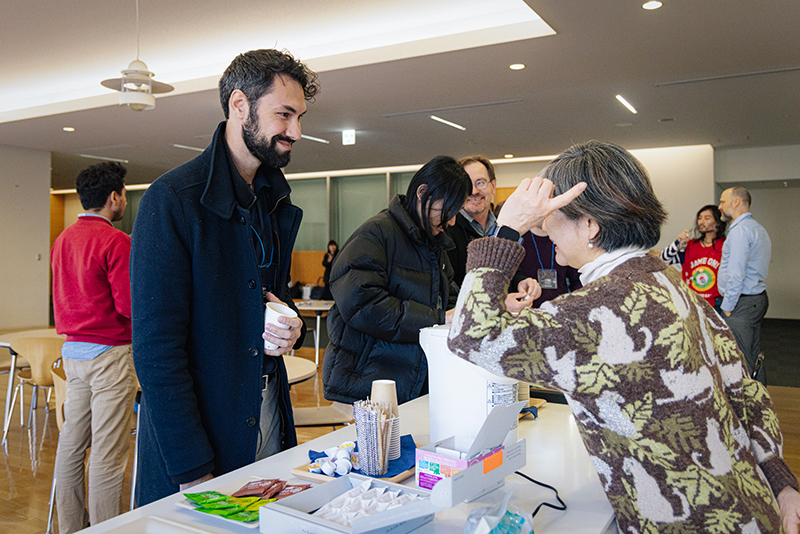
Coffee break during an international conference held in December 2025. Participants mingle while enjoying snacks with a uniquely Japanese flavor.
All-Round Support from Day One
With forty percent of WPI-QUP’s researchers coming from abroad, English serves as the common language. A researcher’s arrival in Japan begins with registering at city hall, opening a bank account, signing up for a cell phone service and more, and WPI-QUP coordinates the necessary support at each step. A detailed schedule is sent to researchers before they travel to Japan, so they know exactly what needs to be done, and arrangements are made to ensure that life in Japan starts smoothly and without unnecessary hassle. Administrators also maintain daily communication with researchers.
“Researchers’ minds are occupied with their research, and they are often under great stress. We try to help them relax by engaging in casual conversation,” Kobayashi explains.
The “Eichi Bar (ħ)”—a kind of science café named after Planck constant in quantum mechanics—is another event initiated by Ikenobe and Kobayashi. Researchers preparing presentations for the general public have opportunities to rehearse their presentations before WPI-QUP administrative staff who provide candid feedback. “Starting with math equations felt a little overwhelming and made it harder to stay interested,” was one such comment. By revising some slides, the speaker turned this feedback into a chance to strengthen their presentation skills. Ikenobe, who does not have a scientific background, reflects, “Not being able to understand is sometimes an advantage, because I can point out things the average listener might struggle with.”
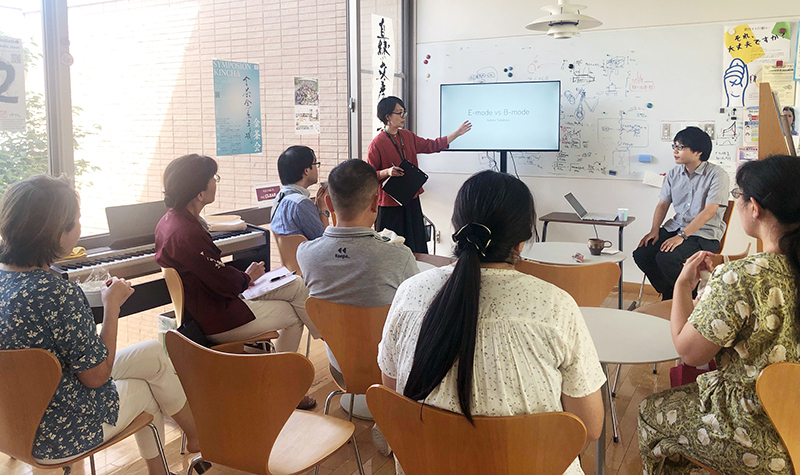
Ikenobe, in her role as navigator, encourages participants to give feedback to a researcher at the “Eichi Bar.”
Some staff members also take the initiative to offer opportunities to experience aspects of Japanese culture, such as planting rice and joining festivals at the nearby Mt. Tsukuba Shrine. “Some researchers make an active effort to learn Japanese or show interest in Japanese culture, and that makes us motivated,” says Kobayashi.
They are attentive hosts, but precisely because they want to preserve a home-like atmosphere, they also enforce clear rules. Researchers can sometimes be relaxed about schedules or slow in submitting paperwork, so the administrators take care to clearly outline the rules that must be followed. After all, failure to comply could potentially affect the trajectory of a researcher’s career. Both kindness and firmness are essential to supporting the scientists in their care.
Ikenobe emphasizes the importance of honest communication within the organization. For example, when composing a news report, disagreement can arise between public relations staff, who prioritize clarity, and researchers, who insist on precision.
“In cases like this, we leave the final decision for another day, to allow time to discuss what is non-negotiable for each party. We don’t ‘compromise’; rather, we look for a ‘touchdown point’ that both sides can accept,” she explains.
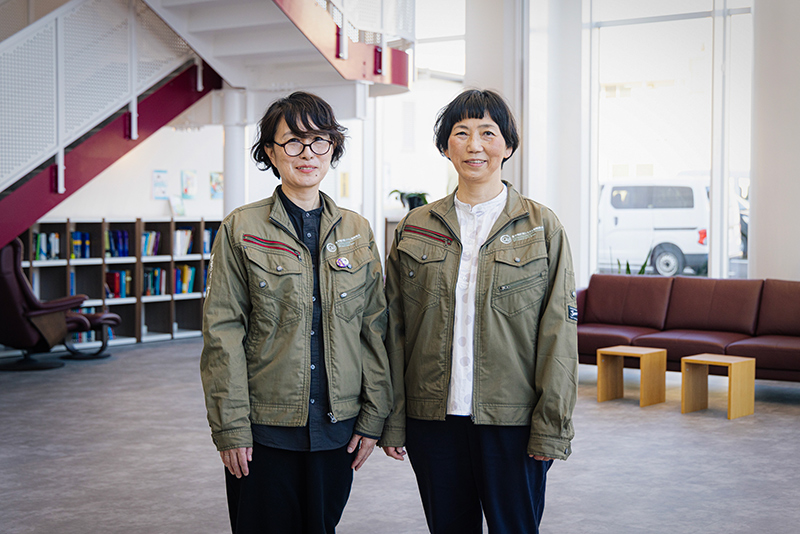
Ikenobe and Kobayashi wear the jackets distributed to all members when WPI-QUP was established. The idea was to nurture a sense of unity.
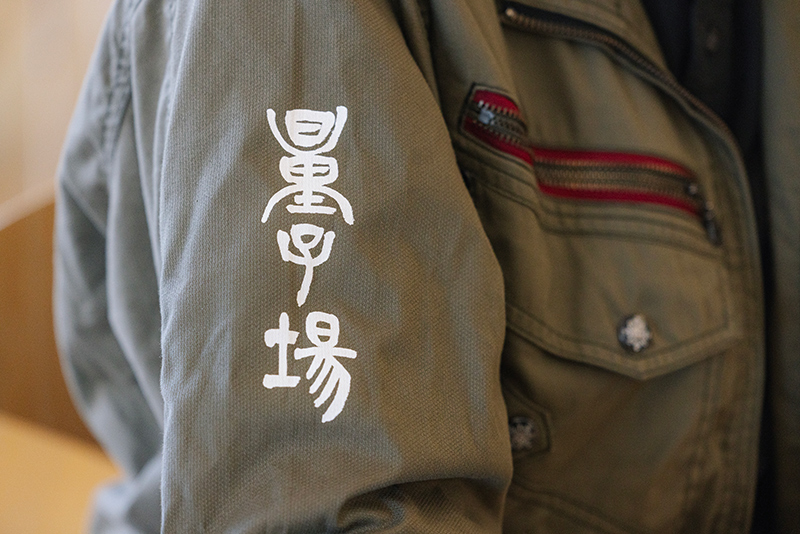
The jackets feature kanji characters for “quantum field” (量子場) printed on the sleeves, rendered in calligraphy by Ikenobe.
Being “Under One Roof” Makes it Easier to Share Concerns
Detailed and comprehensive support from administrative specialists enables researchers to focus on their work, free from unnecessary worries. A new facility completed in October 2025 brings the WPI concept of “Under One Roof” to life. Researchers from different fields can now work together in a shared space to further strengthen connections, and many WPI-QUP members also participate in outreach events.
“English is the shared, day-to-day language, which makes it easier for foreign researchers to carry out their work,” Ikenobe notes. Administrative staff serve as confidants, offering a space where researchers can share personal joys and challenges, whether it’s celebrating the birth of a baby or talking about family matters.
The two pillars—comprehensive support for research activities and a close working relationship between researchers and administrative staff—make WPI-QUP a truly exceptional place for scientific discovery.
IKENOBE Noriko
Technical specialist, WPI-QUP Strategy Office
After seven years of secretarial work at NIMS, Ikenobe joined WPI-QUP in early 2022. She is responsible for managing the website and video messaging, overseeing social media activity, setting up international conferences and workshops, writing news articles, and handling overall public relations.
KOBAYASHI Nobue
Administrative specialist, WPI-QUP Administrative Office
Kobayashi joined WPI-QUP in early 2022 after working for WPI-MANA and WPI-IIIS. Her responsibilities include logistics for international conferences, visa processing and air travel arrangements, export control procedures, and other administrative matters.