
- HOME
- HOME-English
- Careers
- Researchers Voice
- Creating Breakthroughs through the Discovery of New Materials: HARADA Takayuki at WPI-MANA
Creating Breakthroughs through the Discovery of New Materials: HARADA Takayuki at WPI-MANA
Mar 31, 2026
Creating Breakthroughs through the Discovery of New Materials: HARADA Takayuki at WPI-MANA
HARADA Takayuki is an emerging Independent Researcher at the Research Center for Materials Nanoarchitectonics (WPI–MANA), National Institute for Materials Science (NIMS). Working within an exceptionally open research environment granted only to select researchers excelling in their field, he specializes in nanotechnology-based materials research and continues to explore the untapped potential for new substances and materials. Recognized as a promising leader in next-generation materials science, Harada spoke with us about his current work, the research environment that supports it, and his outlook for the years ahead.
*Interviewed in November 2025. Positions and titles are current as of the time of the interview.
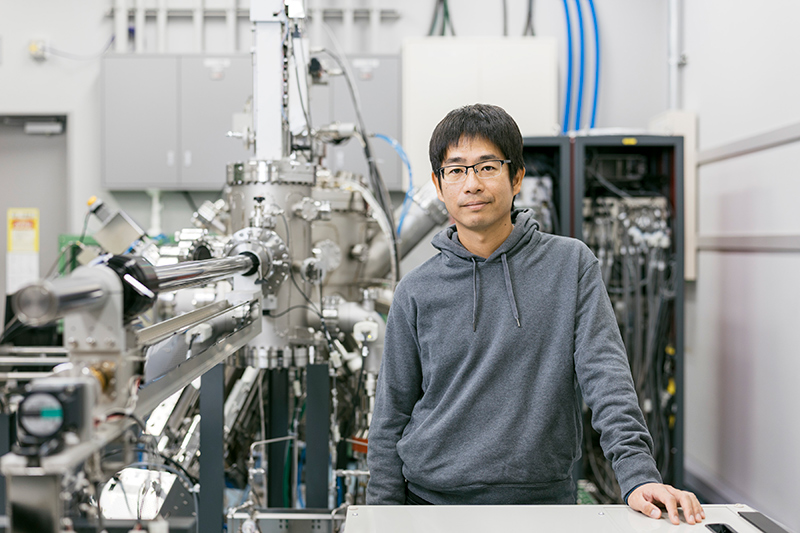
HARADA Takayuki, Independent Researcher, Research Center for Materials Nanoarchitectonics (WPI–MANA), National Institute for Materials Science (NIMS).
Creating Heterostructures Never Made Before
Stepping into Harada’s laboratory, one is immediately greeted by a gleaming experimental apparatus standing nearly two meters tall, its metallic surface still shining with newness.
“We only finished installing this piece of equipment about a week ago,” Harada says, introducing it with evident enthusiasm.
The apparatus is a thin-film deposition system, which instantaneously vaporizes materials and deposits them onto a substrate to form extremely thin, uniform films. Using tools such as this, Harada investigates thin-film heterostructures—structures created by precisely stacking layers of different crystalline materials.
Heterostructures—created by stacking thin films of different crystals to produce physical properties that are more than just the sum of their parts—are in fact all around us, Harada notes, adding that semiconductor devices, for example, can be seen as assemblies of heterostructures. “What I want to do is create heterostructures that no one has ever made before,” he says.”
Harada’s ambitious efforts in heterostructure research have already been widely recognized. In 2022, he received the Young Scientists’ Award by Japan’s Ministry of Education, Culture, Sports, Science and Technology (MEXT), which recognizes young researchers who have demonstrated outstanding research and development capabilities. The award honored his work on applying conductive layered oxides to semiconductor technologies.
In early 2025, he successfully developed nanoscale interconnect materials based on palladium–cobalt oxide that exhibit electrical conductivity comparable to that of gold. As semiconductor devices continue to become smaller and more densely integrated, the demand for new low-resistance interconnect materials is growing. Harada is now working with multiple companies to advance these materials toward practical application.
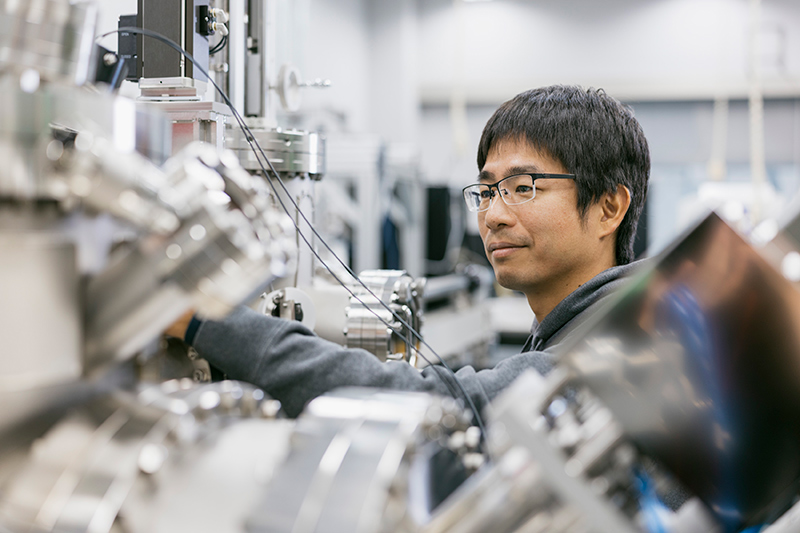
“Everything around us is made of materials,” says Harada. “That’s why even a single new discovery can lead to a real breakthrough.”
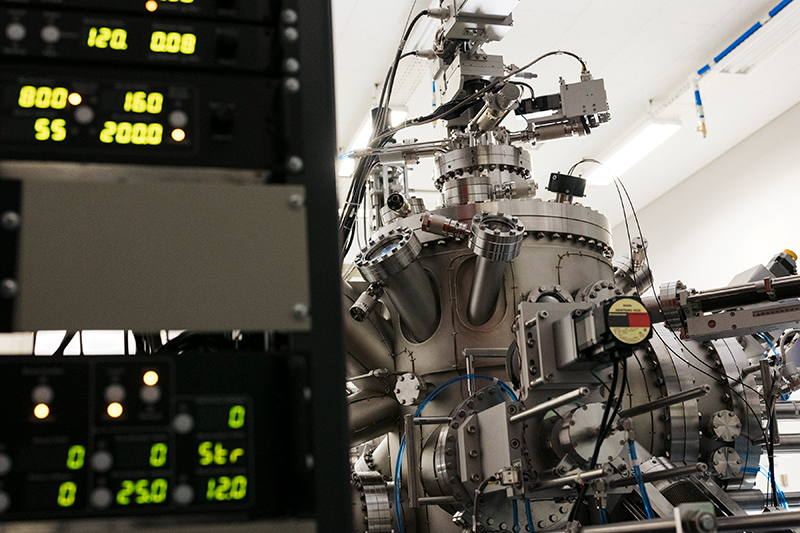
Alongside the newly installed deposition system, the laboratory is equipped with a wide range of experimental instruments.
The Appeal of a Truly Free Research Environment
WPI-MANA is located within the National Institute for Materials Science (NIMS), Japan’s leading research institute dedicated to materials science. As WPI-MANA’s host institution, NIMS provides comprehensive support for all its activities.
“NIMS and WPI-MANA always seemed like places where you could enjoy an exceptionally free research atmosphere,” Harada recalls cheerfully. As a researcher, he places the highest priority on freedom.
“This place embodies freedom. No one tells you what to research—you’re fully free to pursue your ideas. And the shared facilities are so well-equipped that you never have to abandon an experiment because the necessary equipment isn’t available.”
Harada is one of WPI-MANA’s Independent Researchers, a position granted only to young researchers with outstanding achievements. Despite being early in their careers, those selected are granted considerable autonomy, from selecting research themes to managing their own budgets. They also receive strong support for medium- to long-term stays at overseas research institutes, as well as for interdisciplinary collaborative projects.
“My budget is independent, so I secure funding myself. I obtain major funding through competitive programs, while also securing funding by collaborating with companies when my research appears ready for implementation. It feels a bit like being a self-employed entrepreneur who can pursue their own work while still receiving a salary. Some researchers even go on to start their own companies.”
The institute also provides extensive support for industry collaboration, allowing researchers to concentrate on their research without being burdened by paperwork related to contracts and patents.
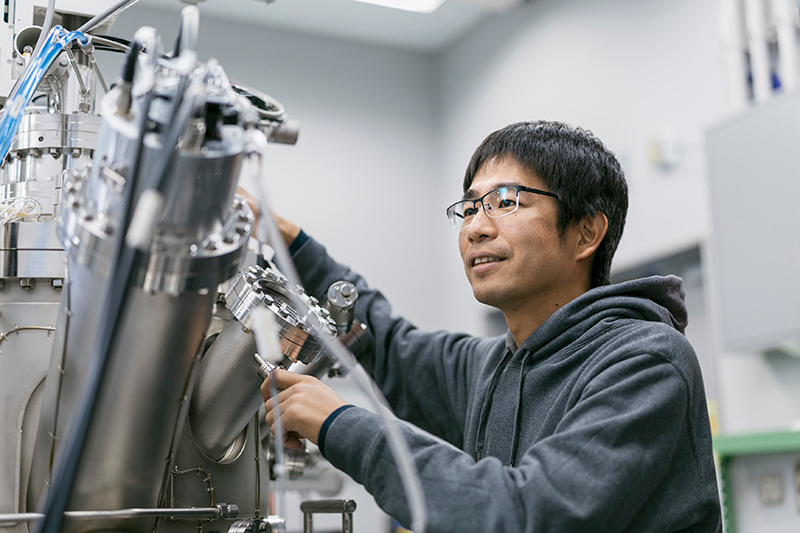
When Harada launched his laboratory, he started with an empty room and brought in the equipment himself. When unexpected costs arose later in the year, WPI-MANA worked with him to find alternative funding solutions.
A Flat Organization—Where You Might Even Play Soccer with the Director
After earning his doctoral degree in engineering from the University of Tokyo, Harada worked as a project researcher at its Institute for Solid State Physics, followed by a postdoctoral position at the Max Planck Institute for Solid State Research in Germany.
Asked why he chose Germany, Harada half-jokingly replies, “Because I like beer and soccer,” before adding, “I wanted to gain research experience abroad—but I always intended to return to Japan after a few years.” Just as planned, he returned after two years to take up an assistant professorship at the Institute for Materials Research, Tohoku University. Later, considering life with his family based in Tokyo, he moved to WPI-MANA, which is located in the Kanto region, near the Tokyo area.
Asked about the differences between research environments in Japan and abroad, Harada replies:
“At NIMS and WPI-MANA there are research groups, but within them each researcher independently pursues the materials that interest them most. This creates a highly positive environment in which diversity in research naturally emerges. I feel that the research environment here is every bit as strong as that of leading Western research institutions such as the Max Planck Institute.”
Harada adds that he sometimes even plays soccer with the director of WPI-MANA. Its flat organizational structures make it easy to communicate and exchange ideas across fields, creating an environment where researchers can casually discuss their work with colleagues from different disciplines. This openness, he says, often leads to new perspectives and sparks ideas that can develop into interdisciplinary research.
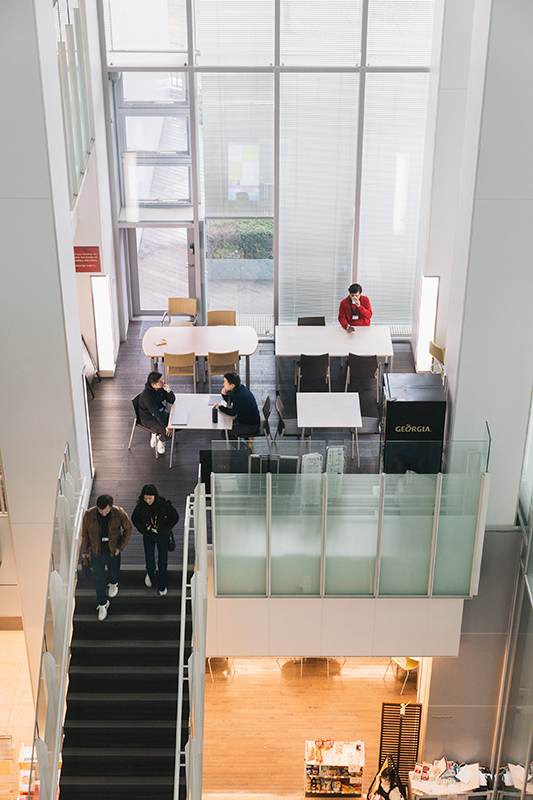
The WPI-MANA building’s open design encourages diverse interactions among researchers, and interdisciplinary collaborations often emerge from casual conversations at the café.
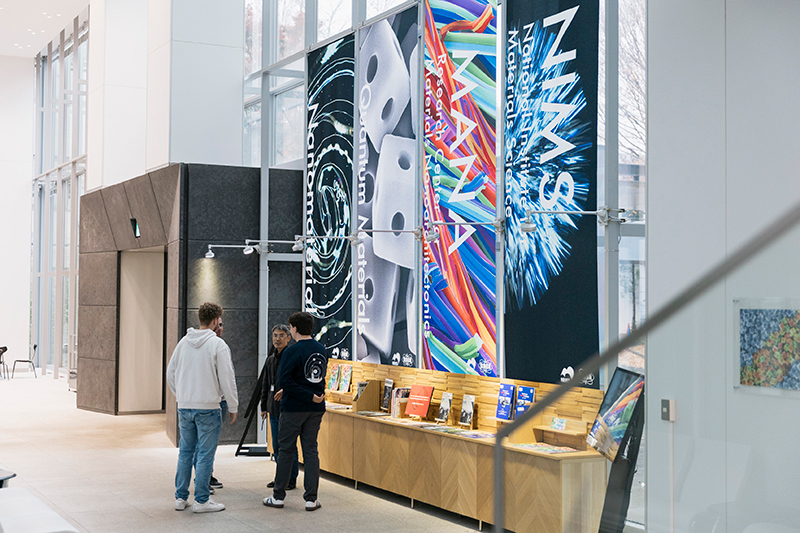
Around 40% of researchers at WPI-MANA come from overseas, contributing to a highly international environment—a hallmark of WPI research centers.
Creating Breakthroughs That Impact the World
“WPI-MANA has an overseas dispatch program that enables researchers to be stationed at institutions abroad,” Harada says of his career plans. “I hope to continue my research at WPI-MANA while making use of these kinds of opportunities. It’s a fun place to work, with both freedom and all the facilities you need. Above all, there is a real sense that your research here can connect to the world.”
Looking ahead, Harada is considering collaborations with industry beyond the semiconductor field. Referring to the invention of the blue LED—which earned the 2014 Nobel Prize in Physics and led to the global spread of LED lighting—he expresses his aspirations to make a discovery that has a real impact in the world.
“To do that, I want to discover all kinds of unconventional materials without focusing too much on applications at first—and then see what new possibilities emerge.”
The day when Harada’s work sparks a breakthrough may not be far off.
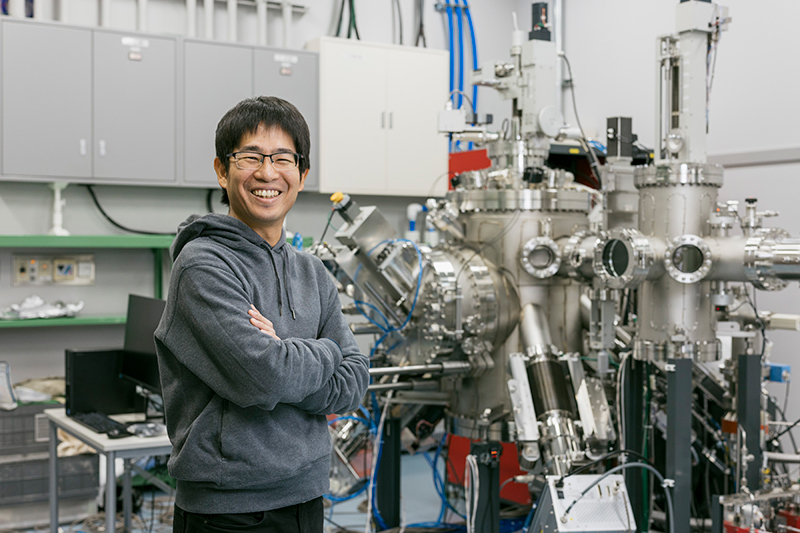
Harada’s laboratory currently consists of seven members, including a postdoctoral researcher from India and a research assistant from Malaysia, with its diversity serving as a stimulus for their research.
HARADA Takayuki
Ph.D. in Engineering, The University of Tokyo (2011)
Project Researcher, Institute for Solid State Physics, The University of Tokyo (2011–2013)
Postdoctoral Researcher, Max Planck Institute for Solid State Research (2013–2015)
Assistant Professor, Institute for Materials Research, Tohoku University (2015–2020)
Concurrent Researcher, JST PRESTO program (2020–2024)
Independent Researcher, National Institute for Materials Science (NIMS) / WPI-MANA (from 2021-2025)
Harada began his career as a principal researcher at WPI-MANA in January 2026.